
Multivibrator Operational Amplifier Circuit
Op amps can easily be used to make a multivibrator circuit with just a few additional components. Circuit is easy and calculations simple.
Op-amp Circuits Include:
Introduction
Circuits summary
Inverting amplifier
Summing amplifier
Non-inverting amplifier
Inverting vs non-inverting circuits
Variable gain amplifier
High pass active filter
Low pass active filter
Bandpass filter
Notch filter
Comparator
Schmitt trigger
Multivibrator
Bistable
Integrator
Differentiator
Wien bridge oscillator
Phase shift oscillator
Multivibrator oscillators are used in many circuits and they are simple to construct. It is possible to construct them using a couple of transistors, but it is also possible to construct a very simple multivibrator oscillator circuit using an operational amplifier. The circuit can be used in a variety of applications where a simple square wave oscillator circuit is required.
The use of an operational amplifier integrated circuit is ideal from many viewpoints. Although circuits can be made using just two transistors, operational amplifiers are also very cheap these days, and there is often little to choose in terms of cost.
In view of the fact that operational amplifiers are very cheap and easy to obtain, they are often preferred to transistors because the operational amplifier multivibrator will use less components and will therefore be easier to build, and therefore more convenient.
Multivibrator circuit
The multivibrator circuit is comparatively simple, requiring on op-amp section along with three resistors and one capacitor as shown below.
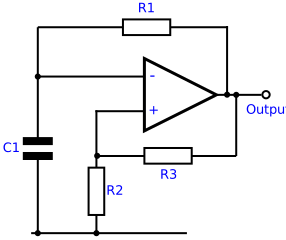
The time period for the oscillation is provided by the formula:
Although many multivibrator circuits may be provided using simple logic gates, this circuit has the advantage that it can be used to provide an oscillator that will generate a much higher output than that which could come from a logic circuit running from a 5 volt supply. In addition to this the multivibrator oscillator circuit is very simple, requiring just one operational amplifier ( op amp ), three resistors, and a single capacitor.
Multivibrator circuit operation
The operational amplifier multivibrator circuit comprises two sections. The feedback to the capacitor is provided by the resistor R1, whereas hysterisis is provided by the two resistors R2 and R3.
More Circuits & Circuit Design:
Op Amp basics
Op Amp circuits
Power supply circuits
Transistor design
Transistor Darlington
Transistor circuits
FET circuits
Circuit symbols
Return to Circuit Design menu . . .