Schmitt Trigger Circuit
The Schmitt trigger is a widely used circuit used with a comparator to provide noise immunity and reduce the possibility of multiple switchings cause by noise on the input.
Op-amp Circuits Include:
Introduction
Circuits summary
Inverting amplifier
Summing amplifier
Non-inverting amplifier
Inverting vs non-inverting circuits
Variable gain amplifier
High pass active filter
Low pass active filter
Bandpass filter
Notch filter
Comparator
Schmitt trigger
Multivibrator
Bistable
Integrator
Differentiator
Wien bridge oscillator
Phase shift oscillator
A Schmitt trigger is form of comparator circuit that has hysteresis or different input switching levels to change the output between the two states.
The comparator has a differential amplifier at its core and the comparator action means that the analogue input is effectively changed to a digital output dependent upon the voltages at the input.
By using the hysteresis, the effect of noise at the input which might cause several switches at the output as the input voltage nears the switching voltage is significantly reduced.
The essence of the Schmitt trigger is a differential amplifier: operational amplifiers are often used in this role, but it is far better to use a specific comparator chip in this role.
What is hysteresis
Hysteresis occurs in many instances throughout science, but in the case of the Schmitt trigger hysteresis means that the circuit triggers at different voltages to switch the output from one state to the other.
To explain this in more detail, take the example where the reference voltage is, say 5 volts. As the voltage rises, dependent upon the circuit is for example 5.5 volts. Then to switch in the other direction, the input voltage must fall to, for example 4.5 volts.
In this way, there is a 1 volt difference between the switching in either direction, and this provides some significant noise immunity.
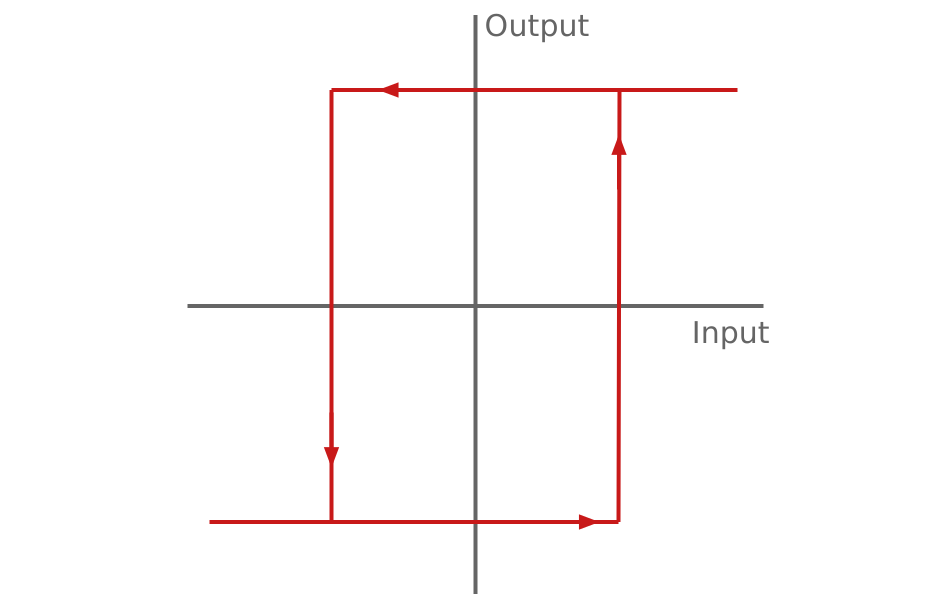
The problem of not using hysteresis with a comparator is that if the input signal rises slowly, then noise on the waveform will cause multiple switches of state of the output of the comparator. By using hysteresis, this issue is overcome, unless the noise levels are very high. The Schmitt trigger circuit is ideal for many applications in overcoming this issue. Fortunately a straight comparator can be converted into a Schmitt trigger by the addition of a single electronic component in most cases
Multiple switches of the output due to noise can give rise to many issues with the following digital circuits, and in very many instances, electronic circuit design engineers have spent many hours debugging circuits with this type of issue as they can be difficult to track down sometimes.
Schmitt trigger basics
The Schmitt trigger circuit has been widely used for many years. It was invented by an American scientist named Otto Schmitt. The Schmitt trigger switches at different voltages depending upon whether it is moving from low to high or high to low, employing what is termed hysteresis.
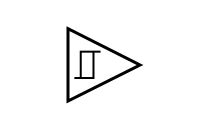
In terms of the fact that the Schmitt trigger has hysteresis, the circuit symbol for one of these circuits incorporates the hysteresis symbol into it. Accordingly all Schmitt triggers use this symbol.
Schmitt trigger circuit
A standard comparator circuit can normally converted into a Schmitt trigger at the electronic design stage by introducing positive feedback by the addition of an additional electronic component. In the circuit below this is provided by the addition of a resistor R3.
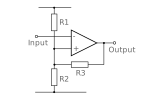
The effect of the new resistor, R3 is to give the circuit different switching thresholds dependent upon the output state of the comparator or operational amplifier. When the output of the comparator is high, this voltage is fed back to the non-inverting input of the operational amplifier of comparator. As a result the switching threshold becomes higher. When the output is switched in the opposite sense, the switching threshold is lowered. This gives the circuit what is termed hysteresis.
The fact that the positive feedback applied within the circuit ensures that there is effectively a higher gain and hence the switching is faster. This is particularly useful when the input waveform may be slow. However a speed up capacitor can be applied within the Schmitt trigger circuit to increase the switching speed still further.
By placing a capacitor across the positive feedback resistor R3, the gain can be increased during the changeover, making the switching even faster. This capacitor , known as a speed up capacitor may be anywhere between 10 and 100 pF dependent upon the circuit.
It is quite easy to calculate the resistors needed in the Schmitt trigger circuit. The centre voltage about which the circuit should switch is determined by the potential divider chain consisting of resistors R1 and R2. This should be chosen first. Then the feedback resistor R3 can be calculated. This will provide a level of hysteresis that is equal to the output swing of the circuit reduced by the potential divide formed as a result of R3 and the parallel combination of the resistors R1 and R2.
Schmitt trigger applications
A Schmitt trigger is used in a host of applications where a level needs to be sensed. Even if only a small amount of hysteresis is used, it reduces the multiple transitions that can occur around the point of switching.
As such the Schmitt trigger applications include many different areas of electronics circuit design.
- Digital to analogue conversion: The Schmitt trigger is effectively a one bit analogue to digital converter. When the signal reaches a given level it switches from one state to the other. This can then be used to drive other digital circuits.
- Level detection: The Schmitt trigger circuit is able to provide level detection. When undertaking this application, it is necessary that the hysteresis voltage is taken into account during the electronic circuit design so that the circuit switches on the required voltage.
- Line reception: When running a data line that may have picked up noise into a logic gate it is necessary to ensure that a logic output level is only changed as the data changed and not as a result of spurious noise that may have been picked up. Using a Schmitt trigger broadly enables the peak to peak noise to reach the level of the hysteresis before spurious triggering may occur.
Schmitt trigger precautions
When using an op amp as a comparator, care must be taken. The op amp chip itself is optimised for closed loop operation with negative feedback. As a result, op amp manufacturers do not guarantee their op amps for use in circuits with no feedback, or with positive feedback as in the case of the Schmitt trigger.
One of the issues is that when an op-amp is used instead of a comparator, the switching speed will not be nearly as high, and it is also unlikely to hit the rails as hard.
Typically comparators are designed for open loop circuit conditions or even use with positive feedback in the case of the Schmitt trigger. They also have an open collector style circuit configuration that is intended for switching hard to the voltages rails as required for logic circuits. For this and many other reasons, comparators will provide much better switching characteristics than an op amp ever could.
Further problems that can arise on some occasions are that when an op amp is driven hard into the rails, it will consume more power than it normally would. An additional problem that can arise is in the form of latching, where the op amp will latch to the voltage rail and remain there not switching regardless of the input levels.
The Schmitt trigger is used in a host of different electronic circuits where analogue signals need to be detected and converted to a digital format. The circuit has ben around for many years and provides a very useful function in many of todays electronic circuit designs.
More Circuits & Circuit Design:
Op Amp basics
Op Amp circuits
Power supply circuits
Transistor design
Transistor Darlington
Transistor circuits
FET circuits
Circuit symbols
Return to Circuit Design menu . . .