There are a number of commonly available RF connectors that are used with coaxial cable to provide screened connections. These coaxial cable connectors are used in a number of areas whether to carry RF or radio frequency signals or just to provide a much higher level of screening than would be possible if more ordinary "open" connectors were used.
RF connectors are used in many areas. Naturally their main uses are associated with RF applications, and normally associated with coaxial cable. Everything from commercial and professional applications through to domestic television, CB and ham radio.
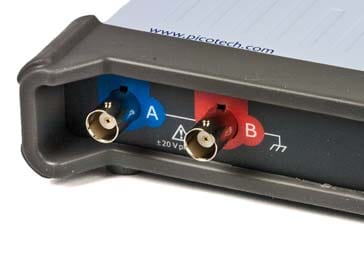
RF connectors or coaxial connectors are also used in areas where screening is one of the major priorities rather than the fundamental RF properties. Coaxial connectors are widely used with a variety of test instruments. For example RF connectors are used on oscilloscopes. These and many other applications all use RF connectors.
Accordingly coaxial cable connectors are used where RF and screening requirements are required. This means that they are somewhat different to the more standard forms of connector used for power and general signal applications.
Coaxial cable connector basics
Many standard connector formats, such as the D-type connectors and many other multiway connectors consist of a series of pins with connections in parallel to each other. RF connectors are typically very different and have some rather different characteristics.
Screened: As radio frequency signals can radiate and conversely there is often the need to prevent extraneous from being picked up. Accordingly RF connectors continue the screening of the coaxial cable as part of their nature.
Circular shape: RF coaxial connectors need to retain the coaxial nature of the cable they are used with and as a result they are circular in shape. As a result they consist of a central pin for the inner of the coax cable, and then an outer connection around the inner for the outer conductor on the cable.
Characteristic impedance: The characteristic impedance of a feeder or coaxial cable is of great importance. Any mismatch will result in power being reflected back towards the source. It is also important that RF coaxial cable connectors have a characteristic impedance that matches that of the cable. If not, a discontinuity is introduced and losses may result, although in reality, this may not affect the majority of installations using frequencies up to, say 250 MHz or so. Most RF connectors are 50Ω, but other impedances like 75Ω for some domestic applications are available along with other impedances for applications like data transmission.
Male normally used for coaxial cables, female fixed: Unlike other forms of connector where there is a convention that the connector supplying the signal or power is the female connector because it is more protected and less likely to be shorted out, the same is not necessarily true for RF connectors. Here connectors on leads tend to be male and those mounted on equipment tend to be female, although in a few instances the standard connector convention may be adopted.
Cable types: As different types of coaxial cable have different dimensions, different variants of coaxial connectors are available to fit a given cable type. It is important to ensure that the right RF connector variant is used with the relevant coaxial cable, otherwise the connector will be difficult to fit, if indeed a reasonable job can be made, and even if it can the connection between the coaxial cable and the RF connector may not be satisfactory.
There is a variety of connectors that are used for RF applications. Impedance, frequency range, power handling, physical size and a number of other parameters including cost will determine the best type for a given applications.
RF connector types
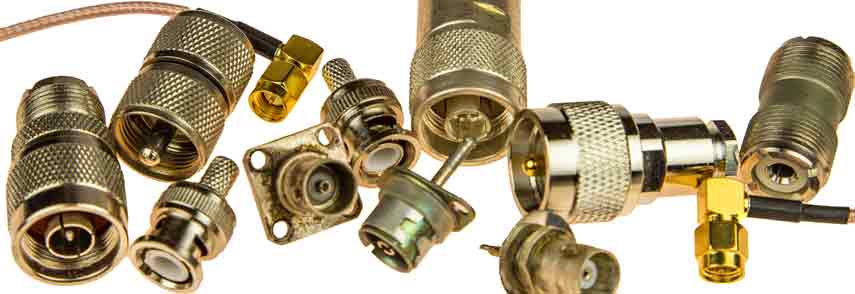
There is a large host of different types of RF or coaxial cable connector. Some are in widespread use whereas others are less widely used. Some of those in widespread use and likely to be encountered in the standard electronics laboratory or by the hobbyist are:
BNC The BNC coax connector is widely used in professional circles being used on most oscilloscopes and many other laboratory instruments. The BNC connector is also widely used as an RF connector, being used on RF test equipment, transmitters, receivers and almost any RF equipment. The BNC connector has a bayonet fixing to prevent accidental disconnection while being easy to disconnect when necessary.
Electrically the BNC coax cable connector is designed to present a constant impedance and it is most common in its 50 ohm version, although 75 ohm ones can be obtained. It is recommended for operation at frequencies up to 4 GHz and it can be used up to 10 GHz provided the special top quality versions specified to that frequency are used.
TNC connector: The TNC connector is a threaded version of the BNC. It was developed to provide low noise reliable connections especially in environments where there may be vibration.
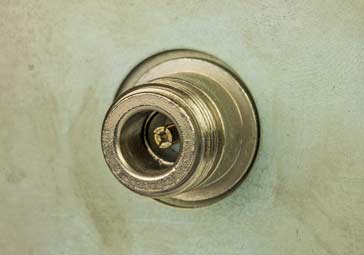
N-type The N-type connector is a high performance RF coax cable connector used in many RF applications. The N-type RF connector is larger than the BNC connector and it has a threaded coupling interface to ensure that it mates correctly. It is available in either 50 ohm or 75 ohm versions. These two versions have subtle mechanical differences that do not allow the two types to mate. The connector is able to withstand relatively high powers when compared to the BNC connector. The standard versions are specified for operation up to 11 GHz, although precision versions are available for operation to 18GHz.
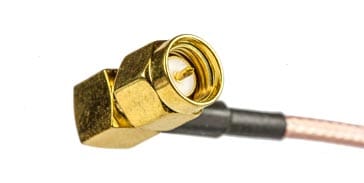
SMA connector: The SMA connector is a sub-miniature RF connector suitable for frequencies up to 12 GHz and more. The connectors are small and provide a reliable RF connection in view of the threaded attachment method.
Although the specification depends upon the manufacturer and the actual part, these connectors are being used in many areas associated with RF and microwave circuitry.
SMB connector: The SMB connector is a smaller snap fit connector that can be used where a fast and easy form of connection is required. The connector is available in 50Ω and 75Ω versions and has a top frequency of around 4 GHz.
Precision, PC series of connectors: The precision series RF connectors are often designated by PC followed by the inner diameter of the outer conductor. They are normally used for very high very high frequency operation, with the top end being able to carry signals at 110 GHz. In view of their performance and the cost of manufacture, these RF connectors are not cheap.
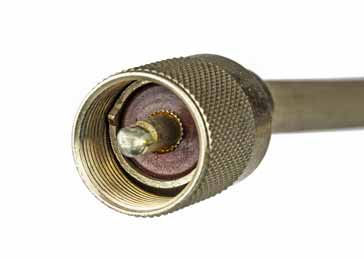
UHF connector (SO239 / PL259): The UHF connector is also sometimes known as the Amphenol coaxial connector. The plug may be referred to as a PL259 coaxial connector, and the socket as an SO239 connector as these were their original military part numbers. These coax cable connectors have a threaded coupling, and this prevents them from being removed accidentally. It also enables them to be tightened sufficiently to enable a good low resistance connection to be made between the two halves.
The drawback of the UHF or Amphenol connector is that it has a non-constant impedance. This limits their use to frequencies of up to 300 MHz, but despite this these UHF connectors provide a low cost connector suitable for many applications, provided that the frequencies do not rise too much. Also very low cost versions are available for applications such as CB operation, and these are not suitable for operation much above 30 MHz. In view of their non-constant impedance, these connectors are now rarely used for many professional applications, being generally limited to CB, amateur radio and some video and public address systems.
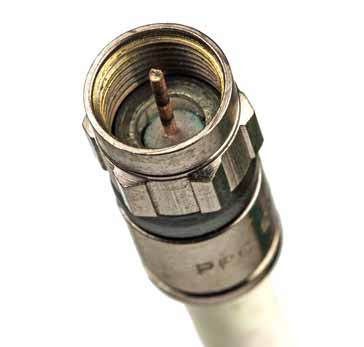
F-type connector: The F-type connector is a low cost coax cable connector suitable for use up to 2 GHz and developed for domestic TV applications.
The RF connector uses the coax centre conductor as the main pin, and maintains a constant impedance across the connector, providing a combination of low cost and good performance.
MCX connector: The MCX connector is one of a number of micro-miniature RF connectors have been developed by a variety of manufacturers. The MCX connector name comes from the words MicroCoaX and it was developed in the 1980s by Huber and Suhner of which MCX is a trade name. The MCX connector has many similarities with the construction of the SMB connector.
The MCX connector is normally specified for operation up to 6 GHz, and it finds applications in a variety of arenas including equipment for cellular telecommunications, data telemetry, Global Positioning (GPS) and other applications where size and weight are important and frequencies are generally below 6 GHz.
MMCX connector: Another connector which is being widely used is the MMCX connector. Being some 45% smaller than an SMB connector, the MMCX is ideal where a low profile outline is a key element. It is therefore ideal for applications where board height is limited, including applications where boards may be stacked. As such it is being widely used in many cellular telecommunications applications.
The connector provides a snap fitting and also utilises a slot-less design to minimise leakage.
The BNC, N-type and UHF (SO239 / PL259) connectors are possibly the most widely used types of connector in many circles. Although many other types of RF connector exist, they tend to be found more in specialised areas of RF technology or in higher cost applications.
RF connectors are widely used in many areas of electronics, covering frequencies from DC up to many GHz. These coaxial cable connectors are an essential part of many electronics equipment, enabling screened connections to be made to the quality required. The performance required of these RF connectors means that costs are not always cheap. While sometimes it is possible to buy cheap coaxial cable connectors, these may be of inferior quality, and they may prove to be a false economy.
Fact of the day: It was on this day in 1965 that Moore\'s Law was first published in an article about the future of semiconductor components. At the time, Gordon Moore who wrote about it was the head of research and development for Fairchild Semiconductor and later he went on to co-found Intel.
Quote:Electric power is everywhere present in unlimited quantities and can drive the world’s machinery without the need for coal, oil, gas or any other of the common fuels. Nikola Tesla
Point to ponder: The degree of technical competence is inversely proportional to the level of management.

 Read more about . . . . BNC connector.
 Read more about . . . . N-type connector.
 Read more about . . . . SMA connector.
 Read more about . . . . UHF connector.
 Read more about . . . . F-type connector.