Morse Code: alphabet, numbers, punctuation & other characters
A Morse code chart or table giving the Morse signals for the alphabet or letters, numbers, punctuation, accented letters and procedural signals.
Morse Code includes:
What is Morse code
How to learn Morse code
Morse code table / chart
Morse code keys & keyers
How to choose the best Morse key
How to use & set-up straight Morse key
How to use & set-up mechanical bug key
CW QSO
The different Morse code characters have been in use since the 1860s when the Morse code was developed. The code which is today called the International Morse code was the second code developed by Samuel Morse.

The International Morse Code refined the first one which had varying character lengths, and the new one was far easier to use. As a result it has been in use for sending telegraph messages as well as radio communications.
These days the greatest use of the Morse code is for ham radio or amateur radio. The use of Morse code enables ham radio operators to use their equipment to contact other ham radio stations over great distances.
The advantages arising from the simplicity of the use of Morse code, allow many ham radio enthusiasts to construct their own equipment as well as allowing contacts to be made when signal strengths are low and interference levels are high.
Video: Morse Code Characters: alphabet, numbers, punctuation, etc
Morse code logic
The Morse code was devised in a fashion that the more commonly used letter were allocated shorter sequences to send.
The original Morse code devised by Samuel Morse was not as easy to use as the later International version, but it still embodied the same basci principles of making common letters easier and faster to send.
In the table of the International Morse code seen below, the letter "e" which is the most commonly used letter in the English language is assigned the symbol of a single dot.
Another common letter "T" is given a single dash as its symbol, and "A" is dot dash, agin these are both easy to send.
Conversely less common letters are given longer symbols: Z is dash, dash dot, dot, and X is dash dot, dot, dash. Both are much longer to send.
By carefully assigning symbols in this way, it makes the Morse code faster and easier to send.
Spacing within Morse code
It is important that the right spaces are maintained when sending Morse code. There are different levels of space between the elements of the same letter, between letters in the same word, and between words.
The standard for the International Morse code includes an agreed definition of the various lengths of dots, dashes and spaces.
By keeping to the required spacing timings, the code is far easier to read - when the timings are not quite right, then it makes things much more difficult to decipher.
If the ratio of dots to dashes is wrong, then the code does not sound good: if the dots are too short then the sending sounds far more "jerky" or if the dots are too long, then it becaomes harder to distinguish between dots and dashes.
- A dash is equal to three dots
- The space between elements which form the same letter is equal to one dot.
- The space between two letters is equal to three dots
- The space between two words is equal to seven dots
By keeping to these lengths the Morse code characters are much easier to read.
Morse code chart / table
The Morse code encompasses a wide variety of different characters - more than just the letters of the alphabet and numbers between 0 and 9.
In this way it has a great amount of flexibility, and enables messages of all types to be sent and received.
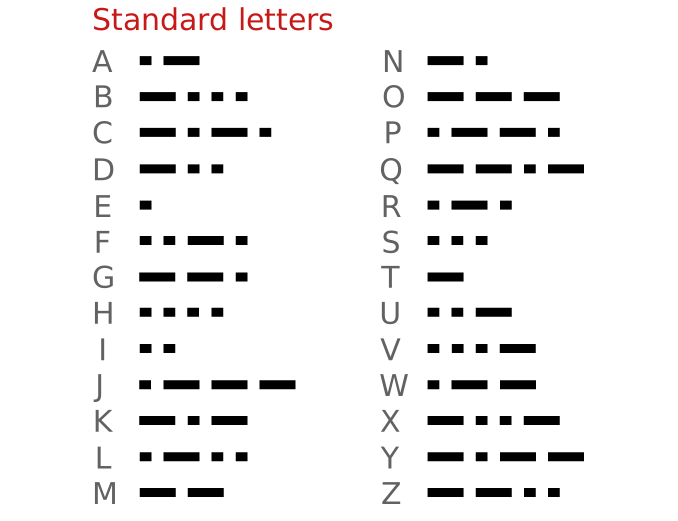
• Morse code alphabet
The Morse code alphabet is covers all 26 letters. Each letter is made up from up to four elements, i.e. dots or dashes.
It is also worth mentioning that the More code alphabet does not distinguish between upper and lower case letters, but this is not an issue as the messages are often written in upper case in messages anyway.
• Morse code numbers
The numbers in Morse code are all consist of five elements, and show a logica progression as the numbers incremenet. This can be seen by looking at the numbers below.
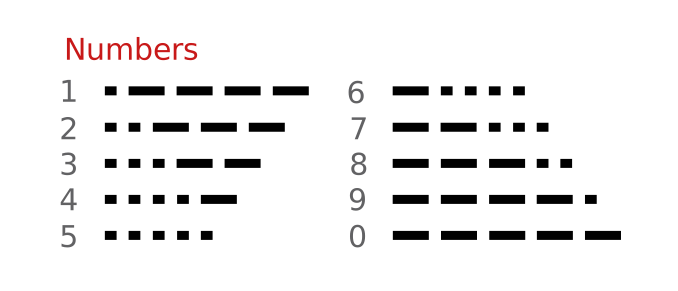
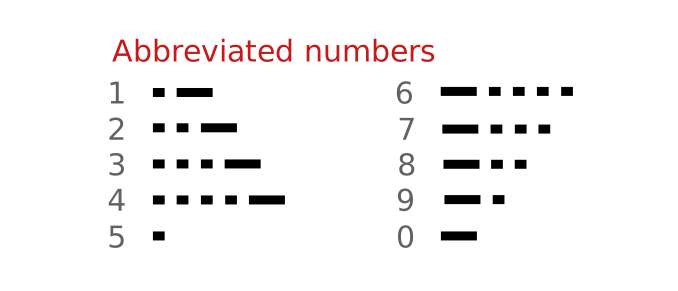
Tbe full length numbers are quite long to send, and as a resul under some circumstances abbreviated numbers may be used.
These abbreviated numbers may be used when a section or message of only numbers is being sent. Also in some messages where it is obvious that a number is being used, an abbreviated number may be used. For example when gving the transmitter power of 100 watts, the zeros may be abbreviated to a single dash or T, or when sending a 599 signal report, it can be abbreviated to 5 N N.
Sometimes the dash for a zero may be extended in length, although this is not standard practice.
• Morse code punctuation
The Morse code character set includes a number of codes to cover the various punctuation characters that are required for many messages.
Although it does not incorporate every single one, a wide variety are used.
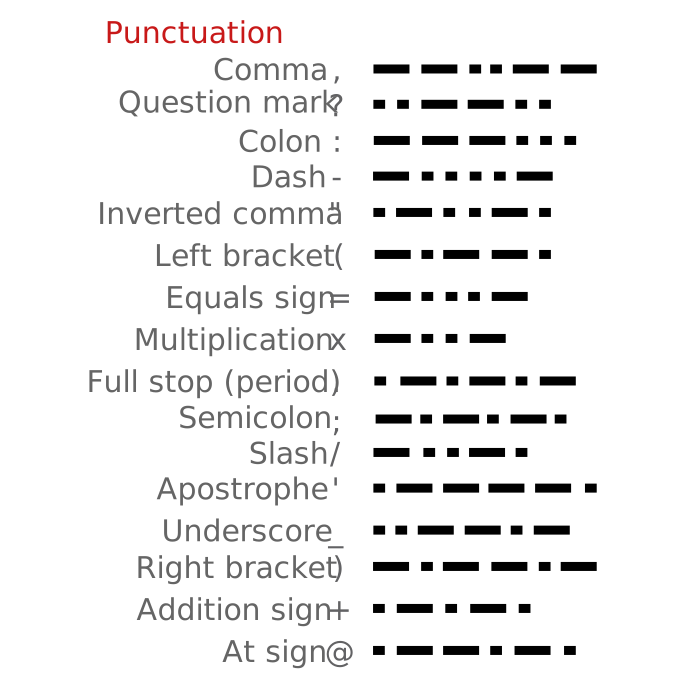
It is worth noting that the equals sign is used as a separator in many messages instead of a full stop / period mark. It is also referred to as the BT sign as it consists a dash, three dots and a dash all sent together,i.e. a B and a T together as one character.
This is used because it is easy to send, and it is very distinct from other characters. A message may use this sign as shown in the example below.
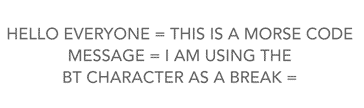
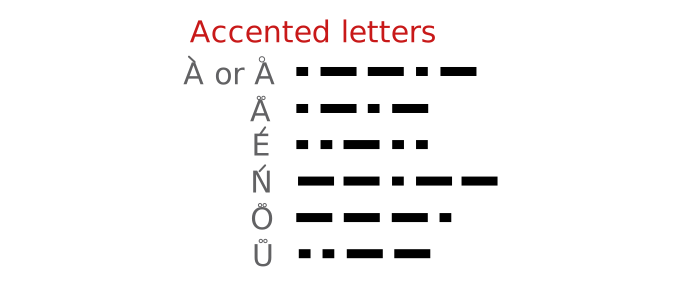
• Morse code accented letters
There are occasions where some letters of the alphabet are required with accents. The International Morse Code alphabet includes a number of accented letters to accommodate the various languages that use them.
There are quite a number of these, but the more commonly used ones are included below.
• Morse code procedural characters
When sending messages over a telegraph or over the radio where a simplex system is used, it is necessary to heve procedural characters included so that the receiving end understands aspects of the messaging like when the message starts and ends, and when there is an invitation for the receiving startion to respond, etc.
These procedural characters are essential to the smooth operation and are intended to unambiguously give the intention of the transmitting station.
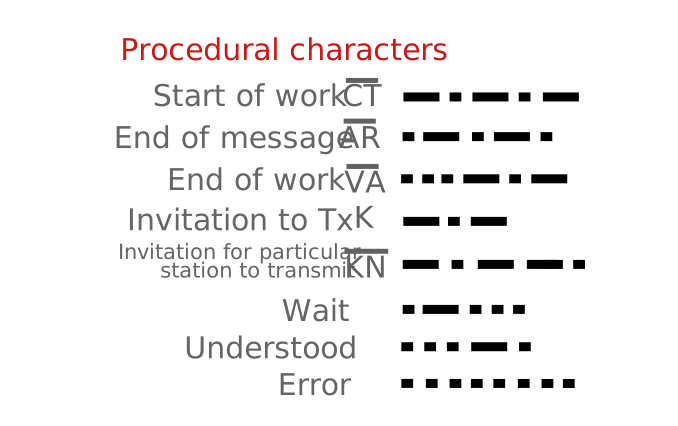
Many of the procedural characters are normally written with a bar across the top of the characters that represent them. Even though they may be considered to be made up from two letters, they are sent as a single character, and the bar across the top indicates this.
Characters such as these are often called a "prosign" as the consist of two letters sent together.
Some letters and procedural characters are those in common use, but the ITU recommendations have also been used. This may result in Morse characters having two slightly different meanings. VA, i.e. End of Work, also is given by the ITU as understood.
Additional Morse code characters
The ITU gives recommendations for a variety of other Morse code characters and occurrences that need to be sent. The ITU defines methods in which these may be sent in Morse code:
- Percentage and per-thousand signs: To indicate the % or per thousand, the figure ), the fraction bar and the figures 0 or 00 shall be successively transmitted (i.e. 0/0 or 0/00).
A whole number, a fractional number or a fraction followed by the % or per thousand sign shall be transmitted by joining up the whole number, the fraction number or fraction to the % or per thousand sign by a single hyphen.
e.g.
For 3%, send 3-0/0 and not 30/0
For 4 1/2 percent, send 4-1/2-0/0 and not 41/20/0 - Minute and second signs: To transmit the minute ' and second '' signs, when such signs follow figures. For example in the case of 1'15'', the apostrophe signal ( . _ _ _ _ . ) shall be transmitted once or twice as appropriate. The signal ( . _ . . _ . ) reserved for inverted commas may not be used for the sign.
- Sending whole numbers and fractions: A number that includes a fraction shall be transmitted with the fraction linked to the whole number by a single hyphen.
e.g.
For 1 3/4 , send 1-3/4
For 3/4 8, send 3/4-8
These additional Morse code characters are not widely used, but can be heard on a number of occasions and therefore it is good to be aware of them.
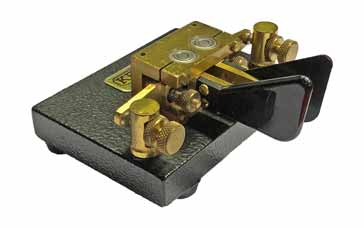
The Morse code is still widely used for amateur radio or ham radio applications. It enables ham radio contacts to be made all over the world with ease, especially when using low powers or more modest antennas. While the Morse code is not generally widely used, it still has applications for ham radio, and the above Morse code chart or Morse code table is useful to identify the main symbols used.
More Ham Radio Topics:
What is ham radio
Callsigns
Morse code
Voice modes
Digital data modes
QRP operating
Operating awards
Codes & abbreviations
Ham bands overview
Operating via differnet propagation modes
Repeaters
Callsigns
Contact formats
Setting up a shack & buying equipment
Return to Ham radio menu . . .