How to Learn & Practice Morse Code
Understand the secrets of how to successfully learn, practice and master the Morse code with hints, tips and all the resources you need to ensure you master it in no time at all.
Morse Code includes:
What is Morse code
How to learn Morse code
Morse code table / chart
Morse code keys & keyers
How to choose the best Morse key
How to use & set-up straight Morse key
How to use & set-up mechanical bug key
CW QSO
The Morse code is still widely used for amateur radio communication as it offers many advantages: it is easy to learn Morse code, especially for sending and receiving for amateur radio.
Once Morse code has been learned you never forget it and it can be practiced and used for making contacts with other stations around the globe.
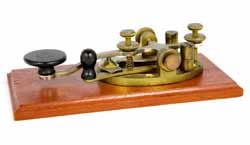
One of the many advantages of learning Morse code is that even today, it is a very effective form of two way radio communication. It enables many contacts to be made with high powered amateur radio equipment as well as allowing low powered or QRP stations to make contacts all around the globe.
The effectiveness of Morse also enables it to be used with simpler home built equipment, making it ideal for really exploring what can be done with equipment you have built yourself and understanding the technology.
Today, Morse code has its rightful place within amateur radio and some other areas as an effective form of modulation for amateur radio communications.
Learning and practicing Morse code can be relatively easy, but some persistence is needed if it is to be successfully mastered.
The Morse code
Before understanding a few more of the secrets of learning Morse code, it is worth looking at exactly what it is and how it works.
Although there are other versions of Morse code, the one that is almsot universally used today is the International Morse code.
The International Morse code consists of a code comprising of dots and dashes, with different combinations of dots and dashes being used for the different letters, numbers and other characters.
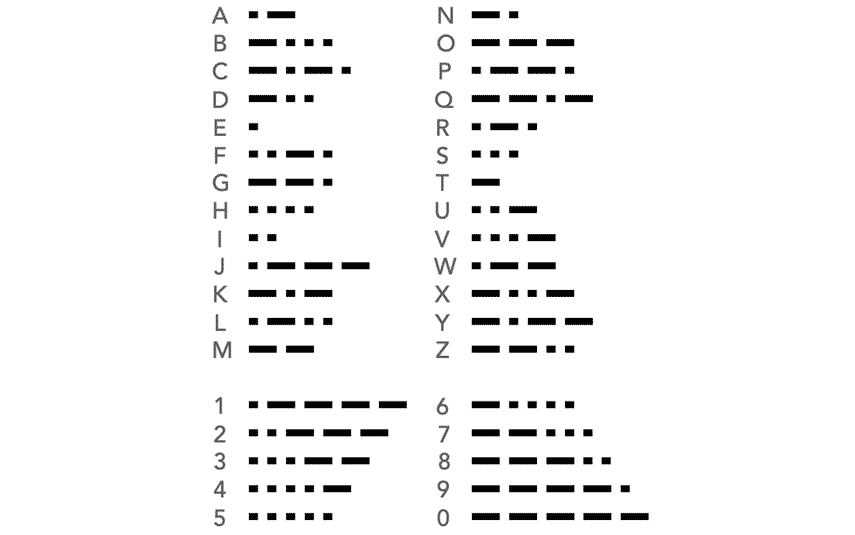
There are defined lengths for the different elements within the Morse characters:
Dot = 1 dot length
Space between elements of character = 1 dot length
Dash = 3 dot lengths
Space between Morse characters = 3 dot lengths
Space between words = 7 dot lengths
How to learn & practise Morse code: the basics
It is relatively easy to learn Morse code and there are several ways in which it can be done. The main requirements are a bit of persistent, and regular practice - it is not difficult to learn.
There is no one way that is right for learning the Morse code. Different people have been successful teaching the Morse code in different ways, and different people respond to the some methods better than others.
In many ways, learning the Morse code is a little like learning a foreign language, the more it is spoken, the easier it becomes. So too with learning the Morse code. A little practice often, preferably each day is far better than a large amount once a week.
Persistence is also needed as it takes time and determination to keep going is needed. Although it can appear as if little progress is being made sometimes, every bit or practice helps and once it has been conquered there it is very rewarding to use.
First steps in learning Morse code
The first step in learning the Morse code is to learn the individual characters themselves. This can be done in a number of ways, how the aim is to be able to hear the rhythmic sound of the code and be able to identify this as a particular letter.
Learning the visual representation and then being able to translate this is not to be recommended as this will take much longer.
This can be done by having a recording of the letters in alphabetical order, or identified by voice in sound. Numbers, etc can be done in a similar way
In this way the particular sound of the letter is directly associated with the letter, or number, etc. Soon it becomes second nature and it is possible to increase the speed much more easily this way.
One tip it to try to learn a small number each day. After this they can be recapped each day to make sure they are properly remembered. In this way thee is less chance of becoming overloaded with too many to learn at once.
However it is worth repeating that the key elements of learning Morse code are regularity and persistence in learning and then practising, and the code will soon be learned.
It is also worth mentioning that it is by far the best to only start sending ocne the proper rhythms of the Morse code have been learned and it is possible to read the characters - read forst and then start sending.
Increasing your speed
Once the basics of the Morse code have been mastered, it is then necessary to start to put it into practice and increase the speed. Typically having learned the code, it will be possible to read Morse code at a rate of about three words a minute.
As most Morse code messages are sent at in excess of 12 words a minute, and often at 20 words a minute or higher, practice and improving the speed is a necessary step in learning the Morse code properly.
While the jump in speed may seem daunting, it comes quite easily with regular practice, and it is not difficult to start making some real improvements very quickly, especially once the basics have been learned.
At this stage some of the techniques listed below may be more helpful to help with regular practice.
- Watch and listen to our Morse code videos.
- Listen to pre-recorded Morse code CDs
- Listen to Morse code from a Morse tutor
- Listen to Morse over the air - this may be too fast at first but persevere.
At this stage the main requirement for learning Morse code is regular practice - typically half an hour a day, and preferably every day is what is really needed. The main objective is to get away from thinking dit-dah, of that is A, to recognising dit-dah as a sound and instantly relating it to A.

Once this transition starts to take place, deciphering the Morse code becomes much easier as well as becoming much faster.
Learn & practice Morse code with Electronics Notes
Here at Electronics Notes, we have prepared a number of videos to help with learning Morse code. These videos start with lessons where the code for letters and numbers is sounded out three times each with the visual indication of the letter. This helps associate the letter with the sound - a key step in how to learn the Morse code.
The videos then progress on varying the order of the letters and numbers so that at each step it is possible to move on a stage.
Further videos are planned and these will aim to steadily improve the efficiency of the Morse code proficiency, aiming towards it being used for two way radio communications contacts within amateur radio.
The number in the title indicates the number in the number of the video lesson. Typically they might be taken in order.
| Morse Code Training Videos | ||
|---|---|---|
| YouTube Video Title & Link | Description of video contents | |
| Morse Code Alphabet Receiving Practice (1) | The Morse code letters sounded out, three times with a visual indication of the character. | |
| Morse Code Numbers Receiving Practice (2) | The Morse code numbers sounded out three times with a visual indication of the number. | |
| Morse Code Letters Receiving, sequential and random (3) | Morse code letters sent, first sequentially, i.e. a, b, c, etc and then in a random order to help further familiarise the letters | |
| Morse Code Numbers Receiving, sequential and random (4) | Morse code numbers sent, first sequentially, i.e. 1, 2, 3, etc and then in a random order | |
| Morse Code Letters Receiving, random order (5) | Morse code letters sent in five letter groups, but no on-screen indications - you can check your receiving by looking in the video description for the text. | |
| Morse Code Numbers Receiving, random order (6) | Morse code numbers sent in five letter groups, but no on-screen indications - you can check your receiving by looking in the video description for the number groups. | |
| Morse Code Letters Receiving, random order (7) | Morse code letters sent in five letter groups, but no on-screen indications - you can check your receiving by looking in the video description for the text. A second video for when a different set of characters is needed. | |
| Morse Code Numbers Receiving, random order (8) | Morse code numbers sent in five letter groups, but no on-screen indications - you can check your receiving by looking in the video description for the number groups. A second video for when a different set of number sets is needed. | |
For those on the move, use our SHORTS videos |
||
| Morse Code Letters Receiving Practice | The Morse code letters sounded out once each with a visual indication of the character. | |
| Morse Code Numbers Receiving Practice | The Morse code numbers sounded out once each with a visual indication of the character. | |
Equipment and resources for learning the Morse code
There are several pieces of equipment and resources that can be purchased or used to help learn the Morse code. Some are more beneficial than others as they will fit into the learning routine better than others. Also it is necessary to find what approach is best for you as different people benefit better from different approaches.
- Morse tutors: Morse tutors can be bought from a variety of sources. They consist of a small box containing electronics that randomly generates Morse code. Depending upon the Morse tutor itself different variations are possible. Some Morse tutor computer programmes are also available.
- Morse recordings: It is possible to buy some CDs of recordings Morse code. These can be a good way to start learning the code, but the problem with them is that the messages being sent are soon learned and it is possible to anticipate the next letter and this considerably reduces their value as a learning aid.
- Watch & listen to YouTube videos: There are some very good videos that are available free of charge to watch and listen to on YouTube. These can provide an excellent resource for use when needed. It is possible to watch this Morse code practice video
Listening off air: This is probably the cheapest option, assuming a radio receiver is available. A huge number of Morse code transmissions can be heard, especially at the bottom ends of the HF ham radio bands where amateur two way radio communications contacts can be heard very easily.
The initial problem may be that the speeds could be quite high, but some slower transmissions can be found especially on bands such as the 80 metre ham radio band, or the 40 metre ham radio band. Soon proficiency will rise and some of the faster transmissions will be able to be copied.
- Listening to slow Morse code transmissions: Some national amateur radio societies have a schedule of slow Morse transmissions. If it is possible to hear them, they can be very useful. Try looking at the ARRL site (www.arrl.org) of the Radio Society of Great Britain (www.rsgb.org). Details can be found of slow Morse transmission schedules.
- Attending Morse code classes: Sometimes it may be possible to attend a Morse code class. If this is possible it can be a real benefit, because the regular encouragement from someone else provides an ongoing stimulus to keep going.
Practice sending: It is often said that sending Morse code should not be started until it is possible to read about 10 words a minute. Certainly sending Morse code is not normally the problem, so the focus should actually be on receiving it.
When sending Morse code, though, concentrate on getting the right spacing and the right rhythm for the individual characters as this is very important. Good habits learned at the outset are more likely to stay with you. Poor sending can be very difficult to read, so it is always best to focus on getting all the lengths and spacings correct.
Don't give up
One of the biggest problems with learning the Morse code is retaining the impetus to learn. Regular practice is the real key - half an hour a day is ideal. Any longer than this and the brain becomes a little tired and the benefit after about half an hour reduces.
By maintaining regular daily practice, learning the Morse code soon becomes more familiar. Learning with someone else often helps. Each person does not want to give up because they feel they will be letting the other one down. This can become a major motivator and a key to the success of learning the Morse code.
Having the skill to use Morse code can be very useful, especially for anyone associated with ham radio and radio communications in general. Although Morse code is not used commercially these days, it nevertheless provides an excellent form of communication for use over the radio where its simplicity, narrow bandwidth, and other advantages give it a unique place. It is well worth preserving and learning it.
More Ham Radio Topics:
What is ham radio
Callsigns
Morse code
Voice modes
Digital data modes
QRP operating
Operating awards
Codes & abbreviations
Ham bands overview
Operating via differnet propagation modes
Repeaters
Callsigns
Contact formats
Setting up a shack & buying equipment
Return to Ham radio menu . . .