What is Morse Code? What is CW?
Despite the fact that Morse code was first used in 1844, Morse code or CW as it is often called still provides a very effective mode often used for two way radio communications.
Morse Code includes:
What is Morse code
How to learn Morse code
Morse code table / chart
Morse code keys & keyers
How to choose the best Morse key
How to use & set-up straight Morse key
How to use & set-up mechanical bug key
CW QSO
The Morse code is a long established form of communication which is still widely used within amateur radio today because of its unique advantages.
Morse code was widely used for more than a century in commercial and professional applications and provided its value in a variety of areas from land line telegraph systems through to radio communications.
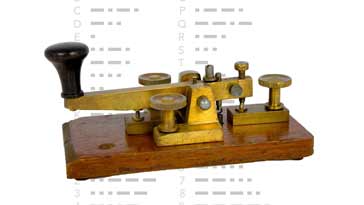
Today the usage of Morse code is much less than it used to be, but the bottom end of many ham radio bands is still packed with many radio hams communicating using the Morse code.
In addition to this, many services that use radio communications still train their users in Morse code in case it is needed for last ditch radio communications, and many radio beacons and similar items may use Morse code to identify themselves.
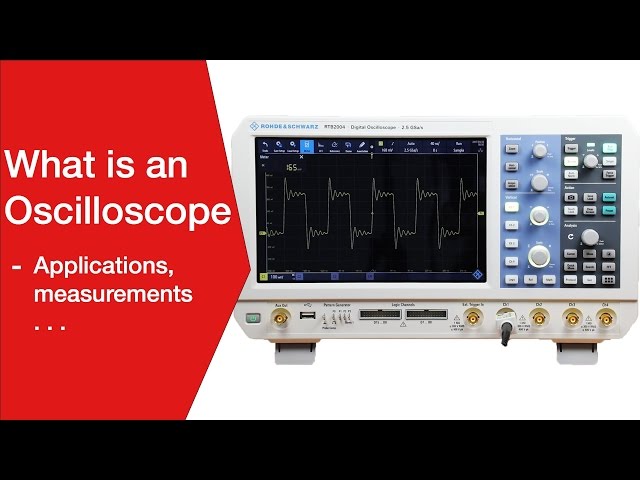
Video: What is Morse Code: all you need to know
In these ways, the Morse code is still very much alive and widely used, even after more than 150 years since it was first used.
Development of Morse Code
The Morse code was developed by Samuel Morse and his associates in the middle of the nineteenth Century and has been in widespread use ever since. Initially the Morse code was used for sending messages over a telegraph system and as a result it became known as the Morse telegraph.
This system became the first widespread method of sending messages over great distances. It was simple to use and flexible, and it soon became a World-Wide standard, allowing communications around the globe.
Later with the invention of wireless or radio communications, the simplicity of the Morse code lent itself to the transmissions of the day, and it soon gained a new applications becoming a mainstay for radio communications for many years.
Nowadays with the development of new technologies, the Morse code has been superseded in terms of technology in many areas of radio communications.
Despite this Morse code can still be heard when listening on the HF radio bands, and in fact it is still in widespread use in amateur radio or ham radio circles. It is still used commercially in a number of areas, but it is not widely used.
What is the Morse code?
The Morse code is a code that uses a series of dots and dashes to represent the different letters of the alphabet, numbers and procedural notations. In this way it is possible to send a message in Morse code by simply turning a signal on and off in the correct manner to represent the dots and dashes.
In the days of the telegraph a message could be sent using a single wire ( and earth return), and for radio communications it could be implemented by turning the transmitted signal or carrier on and off.
The Morse code itself consisted of two elements: a dot and a dash, and the various letters, numbers and other characters were made up by combining these two elements in different combinations.
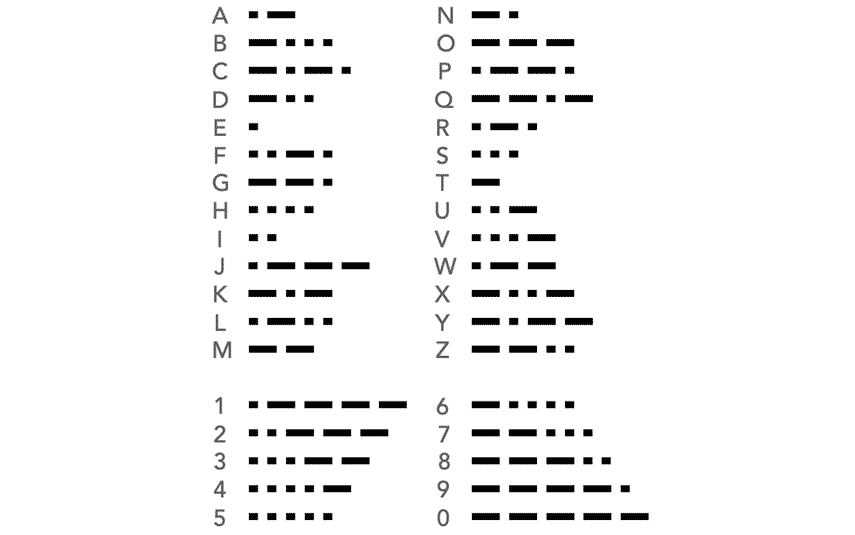
By definition a dot is one unit long, and a dash is three units long. Spaces between adjacent dots and dashes are one unit long, the gap between letters is three units long, and between words it is seven.
Often the dot, was represented by the word "di" and the dash by "dah" tending to represent the sound more easily.
As an example the Morse code for A is a dit followed by a dash: di-dah'.

What is CW & what does CW stand for?
Sometimes the abbreviation CW is used to denote a Morse transmissions. In fact often as a mode the terms Morse and CW are used interchangeably.
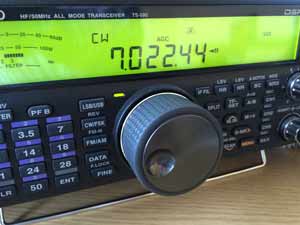
In fact most amateur radio transceivers of transmitters that can transmit a Morse signal have it marked as CW on the mode switch.
Essentially CW refers to a Morse transmission using a radio signal - the abbreviation coming from the fact that it uses a Carrier Wave, or Continuous Wave that is interrupted. There is no modulation (apart from the breaks caused by the Morse characters).
In this way, CW can be used to denote a simple Morse transmission that interrupts the carrier to give the required Morse characters.
Although interrupted audio tones can be used to modulate a signal, this would not strictly be noted as CW. Sometimes the term MCW has been used to denote the term Modulated Carrier Wave.
For standard Morse transmissions the terms Morse and CW are interchangeable - CW being shorter to send in Morse than the word Morse.
Morse keys
There is a huge variety of Morse keys that can be used for sending Morse code. Not only are the shapes and sizes of the basic or straight Morse keys different, but there are also mechanical and electronic keys or Morse keyers available that make sending much easier and faster.
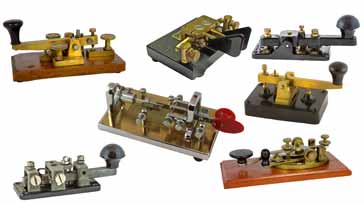
Most Morse keys and keyers mainly fall into in one of three categories:
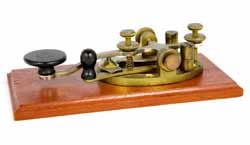
Straight Morse key: The straight Morse key is the traditional form of Morse key that has a lever and uses an up and down motion to make and break the contact and hence make the dots and dashes. It was also the first type of Morse key to be used.
Mechanical semi-automatic keyer: The semi-automatic Morse key was developed to overcome an injury known as telegraph hand, but today we would know as repetitive strain injury, RSI. The key had a paddles and when moved to the left made contact for the dashes, and when moved to the right, it set a vibrating arm in motion to create the dots. Although it took a little time to learn, it reduced the instances of telegraph hand and enabled much faster operation. One of the first keys of this type to be made was the Vibroplex, and these can still be obtained to this day.
Electronic keyer: The electronic keyer is an electronic development of the mechanical key. The basic version has a paddle which creates a series of dashes when moved to the left, and dots when moved to the right. More advanced keyers have two paddles next to each other to provide a "squeeze" function where alternate dots and dashes are produced. These were first known as squeeze keyers but today they are generally known as iambic keyers.
Although full electronic keyers are available, most modern ham radio transceivers have the keyer electronics contained within the transceiver and only the paddle is required. This simplfies their installation and enables fast two way radio communications using Morse code.
These are the main types of Morse key that are in use. Computer technology is also widely used, ad using the right software, messages can be types in on a keyboard and the resulting Morse code is generated. Some software can also read Morse code, but often this is not as good as the human ear at decoding the message int he presence of interference.
How is the Morse code used
The way in which Morse code is transmitted is quite straightforward. For radio applications such as ham radio / amateur radio, all that is needed is a radio frequency signal that can be turned on and off.
In view of the fact that generating the signal is relatively straightforward, this means that the transmitters can be made more easily than for some of the other types of transmission that are heard on the short wave bands. This makes Morse an ideal medium for use in ham radio or amateur radio for those people who like constructing their own equipment.
To receive the signal is a little more complicated. If the signal was received on an ordinary domestic radio, all that should be heard are clicks and plops as the signal turns on and off. To generate the characteristic Morse tone, the radio receiver must be equipped with a beat frequency oscillator, BFO, or carrier insertion oscillator, CIO.
This generates a signal within the receiver that beats with the incoming signal to generate an audio tone that is associated with a Morse signal, and can also be easily read.
Most radio receivers used in ham radio will have a BFO which can be used for receiving Morse code signals. Today most HF band radios will have a mode switch position specifically for Morse / CW. If not specifically marked for Morse or CW, a position marked SSB is equally effective. Some older radios may have a BFO or CIO which needs to be turned on separately.
When transmitted, messages can be sent relatively quickly using the various sets of abbreviations available to ham radio and other radio communications operators. With operators commonly able to send at speeds of 20 words a minute and more, it is possible to communicate effectively and quickly using the Morse code.
Advantages of the Morse code
The are several advantages to Morse code or CW even in these days of advanced technology, digital transmissions and the like:
- Simplicity: It simplicity gives it a number of advantages. The first has already been mentioned and is its simplicity. The overall equipment required for two way radio communications is relatively straightforward and this makes it ideal for ham radio constructors. Simple ham radio transmitters consisting of just a few electronic components: transistors, resistors, capacitors and possibly a quartz crystal can be built and used to make contacts with ham radio stations all around the globe.
- Bandwidth: The rate at which signalling is performed is relatively low and this means that it occupies only a small bandwidth. This gives two advantages. The first is that a large number of stations can occupy a small section of the band, and secondly narrow filters can be used to reduce the level of background noise and interference. Coupled to this the human brain can read Morse signals when they are lower than the surrounding noise level. As a result it is possible to copy a Morse signal at a lower strength than any other form of transmission.
- International appeal: The use a large number of abbreviations and the formalised formats for ham radio contacts means that Morse or CW can be used by people from around the globe even with a poor command of languages like English that are widespread. Using the standard abbreviations basic contacts can be conducted with a limited knowledge of the language of the other person. This may not be possible using other modes of transmission.
Using the Morse code
The main use of the Morse code these days is within ham radio or amateur radio communications, although Morse is still used for identifying directional beacons for aviation, etc.
When using the Morse code, widespread use is made of abbreviations and codes. While this may make any messages difficult to decipher for a newcomer to ham radio, the codes are quickly leaned and their value recognised. They provide a very powerful means of communicating quickly and concisely. By using them it is often found that actual information can be sent almost as quickly as if it was sent via the spoken word.
The use of the codes, forces a much more concise form of communication apart from allowing fewer letters to be sent. The other advantage of using these codes is that they enable ham radio operators who may not be able to speak English (the most widely spoken language on the air) to be able to communicate with a much wider number of people. By using the codes it is possible to communicate with other ham radio stations quite easily with only a minimal knowledge of English.
Morse may not seem to be the latest in technology, and it could never be argued otherwise. However CW still has many advantages within ham radio even in today's high tech world. It is possible to use it when signal strengths are low, and it enables much simpler equipment to be used. For amateur radio operators it is worth giving it a go and tasting some of the pleasure of operating using the Morse code as a serious mode of transmission - possibly with equipment you have built yourself.
More Ham Radio Topics:
What is ham radio
Callsigns
Morse code
Voice modes
Digital data modes
QRP operating
Operating awards
Codes & abbreviations
Ham bands overview
Operating via differnet propagation modes
Repeaters
Callsigns
Contact formats
Setting up a shack & buying equipment
Return to Ham radio menu . . .