RF Mixing / Multiplication: Frequency Mixers
RF mixers or frequency mixers and the process of RF mixing or multiplication is key to many RF circuit enabling signal to be converted from one frequency to another as well as providing phase comparison.
RF Mixers & Mixing Tutorial Includes:
RF mixing basics
Theory & math
Specs & data
How to buy select mixer
Transistor mixer
FET mixer
Double balanced mixer
Gilbert cell mixer
Image reject mixer
One of the most useful RF or radio frequency processes is that of mixing. Unlike an audio mixer where signals are simply added together, when a radio or RF engineer talks about mixing, he means a whole different process. Here signals are multiplied together and signals an new frequencies are generated.
The process of RF or non-linear mixing or multiplication is used in virtually every radio set these days and also in many other circuits beside. It enables signals to be changed from one frequency to another so that signal processing for example can be undertaken on a low frequency where it is easier to perform, but the signal can be changed to a from a higher frequency where the signal is to be transmitted or received.
In fact RF mixing is one of the key processes used in RF circuit design and mixers are seen in very many circuits and items of equipment associated with radio frequency technology.
What happens when signals are mixed
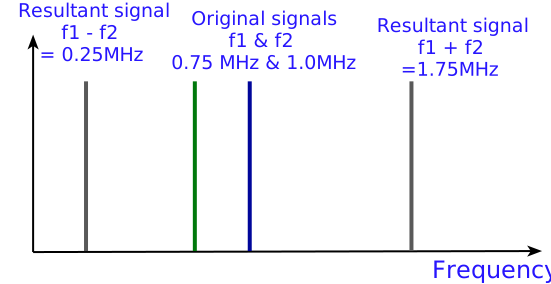
It is found that if two signals are passed through a non-linear circuit, then additional signals on new frequencies are formed. These appear at frequencies equal to the sum and difference frequencies of the original signals.
In other words if signals at frequencies of f1 and f2 enter the mixer, then additional signals at frequencies of (f1+f2) and (f1-f2) will also be seen at the output.
To give an example if the two original signals are at frequencies of 1 MHz and 0.75 MHz, then the two resultant signals will appear at 1.75 MHz and 0.25 MHz.
Why RF mixing or multiplication works
To understand a little more about the RF mixing or multiplication process it is necessary to look at exactly how the mixing process occurs. As mentioned before the two signals are actually multiplied together, and this occurs as a result of a non-linear element in the circuit. This may be a diode, or active devices such as transistors or FETs that are suitably biased.
The two signals can be considered as sine waves. The instantaneous output level is dependent upon the instantaneous level of signal A multiplied by the instantaneous level of signal B. If points along the curve are multiplied, then the output waveform is more complex as shown below.
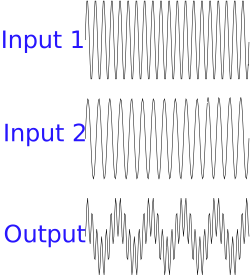
The frequencies used to generate the example below for the frequencies mentioned above, i.e. 0.75 MHz and 1.0 MHz. It can be seen that in the output there is a low frequency component (the difference frequency at 0.25 MHz) and high frequency component (the sum frequency at 1.75 MHz).
In operation, RF Mixers use one of two mechanisms for their operation:
- Nonlinear transfer function: This approach uses device nonlinearities creatively in a manner that intermodulation creates the desired frequency and unwanted frequencies.
- Switching or sampling This is a time-varying process in which elements ofthe mixer are switched on and off by the local oscillator. This method is preferred because creates fewer spurious signals and hence it provides higher linearity for the required output signals.
RF / frequency mixer ports
Frequency mixers of RF mixers come in a variety of formats, but they all have the same basic connections. There are three, and on many frequency mixer modules, they are labelled as such.:
- RF: This is the input used for the signal whose frequency is to be changed. It is typically the incoming signal or equivalent and it is normally at a relatively low level compered to the other input.
- LO: This is for the local oscillator signal. The signal input level for this port is generally much larger than that for the RF input.
- IF: This is the output port for the mixer. It is the port where the "mixed" signal appears.
In an RF design or system where the signal is being converted to a band where the signals are lower in frequency than the incoming signal the circuit block can be referred to as a downconverter, or a down-conversion process. This typically happens in a receiver (although in some radios, signals can be converted up in frequency before they are converted back down again).
Similarly, when the signals are being converted up in frequency, the process can be referred to as up-conversion. This typically occurs in a transmitter and some other RF systems.
Dependent upon the actual RF mixer and the application, the local oscillator signal is typically quite large and may be a continuous sine wave, or a square wave. This local oscillator signal often acts as a gate to the mixer, switching the mixer in line with this signal.
The RF mixer can be considered ON when the LO voltage switches it on and OFF when the local oscillator signal switches it off. This then acts upon the incoming signal on the RF port to enable the two signals to mix and provide the two output signals required.
Types of RF mixer
RF mixers or frequency mixers are available in many forms and there are several types of terminology used to categorise them. Obviously there are the mixers based upon different forms of semiconductor or other technology, but they are also categorised in other ways.
One way in which RF mixers are described is in terms fo the type of device used in them:
Passive mixers: Passive mixers typically use passive components in the form of diodes as the switching element within the RF circuit. As a result they cannot exhibit any gain, but many forms can provide excellent levels of performance.
Passive mixers mainly use Schottky diodes because of their low turn-on voltage, but they require the use of a balun / RF transformer if they are to be used in a balanced or double balanced mixer. This can limit the frequency response.
Active mixers: As the name of the Active RF mixer contains active electronic components like a bipolar transistor, FET or even a vacuum tube / thermionic valve. These types of RF mixer are able to provide gain as well as proving the multiplication or RF mixer capability.
Mixers are also looked at by whether they are balanced or not. Balancing them requires baluns - balanced to unbalanced transformers - but this provides improvements in performance.
Unbalanced mixer: An unbalanced RF mixer is one in which the mixer simply mixes the two signals together and the output consists of the sum and difference signals as well as significant levels of the original RF signal and that of the local oscillator. In some instances this may not be an issue, but in others it can really help to have these removed as part of the frequency mixing process.
Single balanced mixer: A single balanced mixer has a single balun or balancing circuit. Typically single-balanced mixers consist of two diodes along with a hybrid which acts as a balun. Although 90° and 180° hybrids can both be used to design single-balanced mixers, the majority of single-balanced mixers incorporate a 180° hybrid.
The 180° input ports of the hybrid are mutually isolated and this enables the local oscillator port to be isolated from the RF port which prevents the LO signal from affecting the RF input circuits reducing the level of intermodulation products.
Balanced operation can also be achieved using balanced transistor or FET configurations.
These are typically contained within integrated circuits where high levels of performance can be achieved.
Double balanced mixer: The basic traditional double-balanced mixers typically use four Schottky diodes in a quad ring configuration. The baluns or hybrids are placed at both the RF and LO ports, while the IF signal is tapped off from the RF balun.
In operation the double balanced mixer has a high level of LO-RF isolation and LO-IF isolation and it provides a reasonable level of RF-IF isolation. The use of double balanced mixers can reduce the level of intermodulation products by up to 75% when compared to a single diode unbalanced RF mixer.
Like the single balanced mixer, the double balanced mixer can also be replicated using balanced modes of operation within transistor or FET circuit designs. When contained within integrated circuits, these circuit often utilise a double balanced mixer configuration as the additional circuitry required can be incorporated into the OC for negligible increase in cost.
Triple balanced mixer: To improve mixer performance still further it is possible to use a triple balanced mixer.
A triple-balanced mixer is effectively made from two double balanced mixers and as a result it is sometimes called a doubly double balanced mixer. It utilises many more electronic components having two diode bridges or quads, with a total of eight junctions. Power splitter at the RF and LO microwave baluns feed the mixer structure, and this allows for both of the diode quads to be coupled. This allows for the IF signal to be available at two separate isolated terminals, that typically exhibit very large bandwidths compared to other mixer architectures.
The improved isolation provided by the triple balanced mixer provides for much higher levels of spurious signal, intermodulation distortion suppression.
The improvement in performance needs to be offset against the fact that they need higher levels of LO drive, and of course the increased complexity and electronic component count result in increased cost.
RF mixer circuit symbol
The key RF mixer circuit symbol shows the two signals entering circuit block consisting of a circle with a cross or "X" within it. This is widely used in the circuit schematics for many RF circuit designs. It is typically used when an RF mixer module is used.
This circuit symbol indicates the multiplication aspect of the mixer.
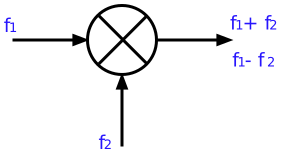
In some instances the different ports to the mixer will be suitably labelled: RF, LO, IF.
RF mixer circuits
RF mixers or frequency mixers can be realised using a variety of RF circuit designs. Also different circuits have different levels of complexity and use different numbers and types of electronic component. Accordingly the cost, specifications, operation and other aspects mean that when undertaking any RF circuit design, the different types of frequency mixer may be more applicable to one situation than another.
There is an enormous variety of different types of circuits including:
Single diode mixer: This form of RF mixer or frequency mixer is the simplest form available, using very few electronic components. Accordingly the level its performance far less than that of some more sophisticated designs using additional and often more expensive electronic components.
Basic transistor RF mixer:
Read more about . . . . Bipolar Transistor RF Mixer.
Basic FET mixer:
FETs are ideal electronic components to used for mixing. Having a good switching capability and the ability to use two gates if a dual gate MOSFET is used, these devices provide excellent performance.There are many different circuits for FET mixers, each one having its own advantages and disadvantages.
Read more about . . . . FET RF Mixer.
Single-balanced diode mixer: The single balanced diode mixer provides isolation of the local oscillator from one of the other ports. It is straightforward and works well, although because of the limited isolation between ports, it will give rise to higher levels of intermodulation distortion.
Double-balanced diode mixer: The double balanced diode mixer provides increased isolation - isolating the the LO-RF and LO-IF ports. It requires two baluns and four diodes. The diodes used are normally Schottky diodes because of their low turn on voltage. In view of the increased isolation capabilities, the levels of intermodulation distortion are lower than those of the single balanced mixer.
Read more about . . . . Double Balanced Diode RF Mixer.
Gilbert cell mixer: The Gilbert cell mixer is often used within integrated circuits that are used for radio receiver and other RF design applications. In view of the number of electronic components needed, they are not seen so often being built from discrete electronic components. The Gilbert cel mixer performs particularly well, being able to offer double balanced operation using the differential inputs, etc of long tail pair transistor or FET circuits.
Read more about . . . . Gilbert Cell Mixer.
RF Mixer applications
RF mixers or frequency mixers are used in all areas of RF design, and development. They are used in circuits from radio receivers and transmitters to radar systems, and in fact anywhere that radio frequency signals are used.
These mixers can be used in a variety of different ways:
- Frequency translation: The most obvious application for RF mixers is for frequency translation. This technique is used in many areas and in particular in receivers and transmitters to move the frequency of a signal from one band to another. Using the fact that the two input frequencies generate sum and difference frequencies, it is possible to change the signal input to another frequency by taking either the sum or the difference signal. One of the first major applications of this was in the superheterodyne radio receiver.
- Phase comparison: Using a mixer it is possible to detect the phase difference between two signals. This RF mixer application can be used in many areas, one of which is within phase locked loops.
RF mixers or frequency mixers as they are often called, are one of the main building blocks for RF circuit design. Frequency translation is a major capability, used in a host of different applications, and it is a key element of radio communications equipment technology: both for transmitters and receivers. IN addition to this, mixers can be used as phase detectors for many applications including many phase locked look and synthesiser RF designs.
Accordingly understanding RF mixer operation and the different types and their use, is essential for anyone involved in RF design, systems development, or the operation of any RF or radio communications equipment.
More Essential Radio Topics:
Radio Signals
Modulation types & techniques
Amplitude modulation
Frequency modulation
OFDM
RF mixing
Phase locked loops
Frequency synthesizers
Passive intermodulation
RF attenuators
RF filters
RF circulator
Radio receiver types
Superhet radio
Receiver selectivity
Receiver sensitivity
Receiver strong signal handling
Receiver dynamic range
Return to Radio topics menu . . .