What is an Analog Multimeter - Analogue Meter?
Analogue multimeters are test instruments that are able to measure the basic electrical and electronic quantities of voltage, current and resistance.
Multimeter Tutorial Includes:
Test meter basics
Analogue multimeter
How does an analogue multimeter work
DMM digital multimeter
How a DMM works
DMM accuracy & resolution
How to buy best digital multimeter
How to use a multimeter
Voltage measurement
Current measurements
Resistance measurements
Diode & transistor test
Fault finding transistor circuits
A analog or analogue multimeter is one of the trusty workhorses of the electronics test industry being used to make a wide variety of basic measurements.
Analogue multimeters have been in use for very many years and sometimes go by the name VOA as a result of the fact that they measure volts, ohms and amps. These multimeters are extremely flexible and enable very many faults to be found in an electronic circuit.
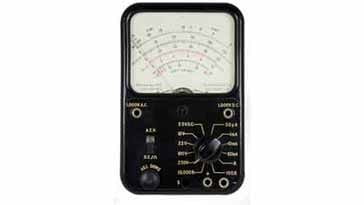
Although analogue multimeters are now less common because digital multimeters, or DMMs are now more common, some analogue test meters are still available and may be found in some laboratories or may be available for use at home, etc.
The analogue test meters are able to give a good account of themselves and can provide readings that are sufficiently accurate for most purposes.
They do require a few different skills to the digital multimeters that are more widespread these days, but they are still very easy to use and very useful.
What is an analogue test meter
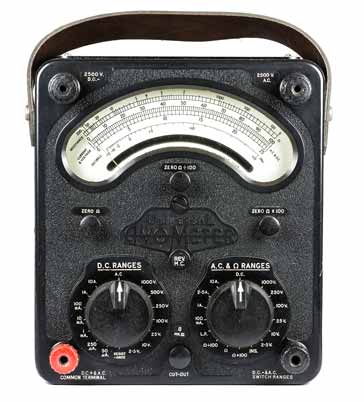
Analogue multimeters or test meters are test instruments based around the use of a moving coil meter.
This is an analogue form of display that uses the deflection of an indicator needle to indicate the level of the measurement being made.
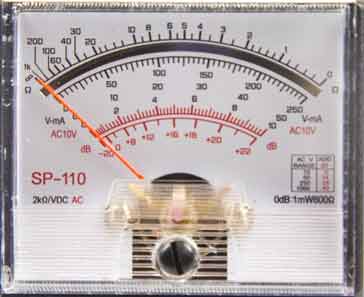
The basic meter used in an analogue meter is a moving coil meter and this deflects from its rest position increasingly as the measurement quantity increases.
These meters were a feature of many laboratory views photographed before the period between the 1970s and 1990s when digital technology really started to totally supplant analogue techniques.
The analogue test meter typically contained a single meter and movement, and series and parallel resistors were used to provide the correct ranges.
Typically a large rotary switch in the centre of the front panel under the meter was used to select the required range.
There are sometimes a number of different connections used for the probes. There are normally a 'common' and a normal measurement probe connections.
The normal connections are often labelled Amps, Volts, Ohms or similar indicating they are for the 'normal' measurements.
Also for some measurements with either very high or low current, etc, a different probe connection may be used. These other probe connections may be designated 10Amps for a ten amp range, or microamps for a µamp range, etc.
Meter reading parallax errors
One cause of errors on an analogue multimeter, or any analog meter for that matter is parallax errors. This is an important concept when using an analogue multimeter.
When viewing the meter, the eye should be at right angles to the plane of the meter back markings, i.e. looking directly at the meter. In this way there is no error from viewing the needle at an angle. If you look to one side, then the meter reading that is viewed can be incorrect.
Some high end professional meters such as the AVO have a mirror in the scale. In this way it is possible to assess whether the eye is directly in front of the scale - when the eye is viewing correctly, it will not be possible to see the reflection of the meter needle as it is masked out by the needle itself. The offset view below indicates this.
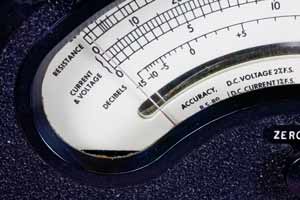
This offset view shows the reflection of the meter needle and how this can lead to reading errors.
Analog multimeter ranges
Analog multimeters, like digital ones have a variety of ranges. They are described in terms of Full Scale Deflection or FSD. This is the maximum that the range can read. In order to get the best reading, it is necessary to have the scale reading somewhere between about a quarter and all of the FSD.
In this way the optimum accuracy and significant number of figures can be read. As a result of this meters have a variety of ranges, that may appear to be reasonably close to each other.
A typical meter may have the following ranges (note that the figures indicate the FSD):
- DC Voltage: 2.5V, 10V, 25V, 100V, 250V, 1000V
- AC voltage: 10V, 25V, 100V, 250V, 1000V
- DC Current: 50µA, 1mA 10mW, 100mA
- Resistance: R, 100R, 10 000R
There are several points to note from this typical analogue multimeter specification:
- The low voltage AC voltage, and in this example the 10V AC range may have a different scale to the others. The reason for this is that at low voltages a bridge rectifier is non-linear and this needs to be taken into consideration. It is also for this reason that no 2.5V AC range was included.
- The 1000V or 1kV ranges will often use a different input connection to enable the reading to be taken through a different shunt and kept away from the rotary switch that may not be able to handle a voltage this high.
- AC current is often not included in the lower end meters because of the difficulties of undertaking the measurement without a transformer to step up any voltage across a series sensing resistor for rectification.
- Batteries inside the multimeter are used to provide a current for the resistance measurements. No other readings require the use of battery power - the meter is passive from that viewpoint.
- The three resistance ranges of varying sensitivity multiply the meter reading by 1, 100, or 10 000 dependent upon the range. This allows for low resistance measurements to be made as well as very high ones. Typically the higher resistance ranges may use a higher voltage battery than the one used for the low resistance ranges.
dB scales and ranges
Some analogue multimeters will have a dB scale on them. The analogue meter is not a power meter and it also cannot directly compare readings to provide a ratio.
The readings are typically used for looking at the standard line audio signals and the decibel readings are relative to 1mW into 600Ω. This assumes the use of a 600Ω line for these readings.
This standard was most likely inherited from the old telephone / telecommunications links for which many test meters would have been used in the maintenance.
The use of an analogue multimeter would have been commonplace for testing the AC audio levels because oscilloscopes would have been reserved for the laboratories and not as commonplace in the exchanges and various other points where testing would have been required.
To use the meter on the dB range it must be set to the AC range and typically the signal must be an audio frequency - not too high (20kHz should be OK for most meters) otherwise the frequency response of the meter may reduce the reading.
There may be different scales for different AC ranges to accommodate the different signal levels. It is necessary to select the range that best suits the signal.
Analog multimeter sensitivity
One of the specifications for an analogue multimeter is its sensitivity. This comes about because the meter must draw a certain amount of current from the circuit it is measuring in order for the meter to deflect. Accordingly the meter appears as another resistor placed between the points being measured. The way this is specified is in terms of a certain number of Ohms (or more usually kΩ) per volt. The figure enables the effective resistance to be calculated for any given range.
Thus if a multimeter had a sensitivity of 20 kΩ per volt, then on the range having a full scale deflection of 10 volts, it would appear as a resistance of 10 x 20 kΩ, i.e. 200 kΩ.
When making measurements the resistance of the meter should be at the very least ten times the resistance of the circuit being measured. As a rough guide, this can be taken to be the highest resistor value near where the meter is connected.
Normally the sensitivity of an analog meter is much less on AC than DC. A meter with a DC sensitivity of 20 kΩ per volt on DC might only have a sensitivity of 1 kΩ per volt on AC.
Multimeter operation
The operation of an analog multimeter is quite easy. With a knowledge of how to make voltage, current and resistance measurements it is only necessary to know how to use the multimeter - these test instruments are very easy to use.
If the meter is new then it will obviously be necessary to install any battery or batteries needed for the resistance measurements. No battery is needed for the measurements for current and voltage.
When using the meter it is possible to follow a number of simple steps:
- Insert the probes into the correct connections - this is required because there may be a number of different connections that can be used.
- Set switch to the correct measurement type and range for the measurement to be made. When selecting the range, ensure that the maximum range is above that anticipated. The range on the multimeter can be reduced later if necessary. However by selecting a range that is too high, it prevents the meter being overloaded and any possible damage to the movement of the meter itself.
- Optimise the range for the best reading. If possible adjust it so that the maximum deflection of the meter can be gained. In this way the most accurate reading will be gained.
- Once the reading is complete, it is a wise precaution to place the probes into the voltage measurement sockets and turn the range to maximum voltage. In this way if the meter is accidentally connected without thought for the range used, there is little chance of damage to the meter. This may not be true if it left set for a current reading, and the meter is accidentally connected across a high voltage point!
Analog meter advantages & disadvantages
One of the key points of knowing how to use an analog multimeter is understanding the relevant advantages and disadvantages.
Like any item of test equipment an analogue multimeter or test meter has its limitations. Knowing what they are and how to overcome them is a key stage in understanding how to use an analogue multimeter to its best.
Advantages:
- Analogue movement: The meter needle gives a continuous movement from which it is very easy to gain a fast idea of the order of magnitude, or of trends for slowly moving changes. This is not always so easy using a digital multimeter.
- Low cost: Analogue multimeters can be bought very cheaply these days.
- Availability: These pieces of test equipment are still widely available from many sources despite the fact that digital multimeters tend to be more widely used.
- Preference: Some people prefer to use an analogue meter - it is very easy to glance at it and gain a very good indication of the approximate value of the reading.
Disadvantages:
- Multiple scales: Any multimeter will have a number of different scales and these can cause confusion. They were often a cause of error.
- Lower input resistance: Using analogue technology, analogue multimeters did not provide such a high input impedance as a digital one. Understanding when this may be an issue is a key element of knowing how to use an analogue multimeter.
- Polarities of test leads: Analogue multimeters do not have an auto-polarity function. Therefore it is necessary to correctly connect the test leads, otherwise the meter could deflect in a negative direction and quickly hit an end stop.
- Less accurate than a digital multimeter: Analogue multimeters are typically less accurate than digital test instruments. That said the measurements are sufficiently accurate for most of the measurements that need to be made.
Analogue multimeters or test meters formed the main form of test equipment used in many areas for many years. Although now mainly superseded by digital multimeters, analogue test meters are still found in many places, where they can still provide the measurement capabilities needed for most tests. These analogue multimeters can also still be bought new as well for those who prefer an analogue meter to read rather than a digital display.
More Test Topics:
Data network analyzer
Digital Multimeter
Frequency counter
Oscilloscope
Signal generators
Spectrum analyzer
LCR meter
Dip meter, GDO
Logic analyzer
RF power meter
RF signal generator
Logic probe
PAT testing & testers
Time domain reflectometer
Vector network analyzer
PXI
GPIB
Boundary scan / JTAG
Data acquisition
Return to Test menu . . .