
What is Electric Current: the basics
Electric current results when electric charges move - these may be negatively charged electrons or positive charge carriers - positive ions.
Electric Current Tutorial Includes:
What is electric current
Current unit - Ampere
AC & DC
Electric current is one of the most basic concepts that exists within electrical and electronic science - electric current is at the core of the science of electricity.
Whether it is an electrical heater, a large electrical grid system, a mobile phone, computer, remote sensor node or whatever, the concept of electrical current is central to its operation.
However current as such cannot normally be seen, although its effects can be seen, heard and felt all the time, and as a result it is sometimes difficult to gain a view of what it really is.

Photo taken from top of Petronas Towers in Kuala Lumpur Malaysia
Electrical current definition
Electric current definition:
An electric current is a flow of electric charge in a circuit. More specifically, the electric current is the rate of charge flow past a given point in an electric circuit. The charge can be negatively charged electrons or positive charge carriers including protons, positive ions or holes.
The magnitude of the electric current is measured in coulombs per second, the common unit for this being the Ampere or amp which is designated by the letter ‘A’.
The Ampere or amp is widely used within electrical and electronic technology along with the multipliers like milliamp (0.001A), microamp (0.000001A), and so forth.
Current flow in a circuit is normally designated by the letter ‘I’, and this letter is used in equations like Ohms law where V=I⋅R.
What is electric current: the basics
The basic concept of current is that it is the movement of electrons within a substance. Electrons are minute particles that exist as part of the molecular structure of materials. Sometimes these electrons are held tightly within the molecules and other times they are held loosely and they are able to move around the structure relatively freely.
One very important point to note about the electrons is that they are charged particles - they carry a negative charge. If they move then an amount of charge moves and this is called current.
It is also worth noting that the number of electrons that able to move governs the ability of a particular substance to conduct electricity. Some materials allow current to move better than others.
The motion of the free electrons is normally very haphazard - it is random - as many electrons move in one direction as in another and as a result there is no overall movement of charge.
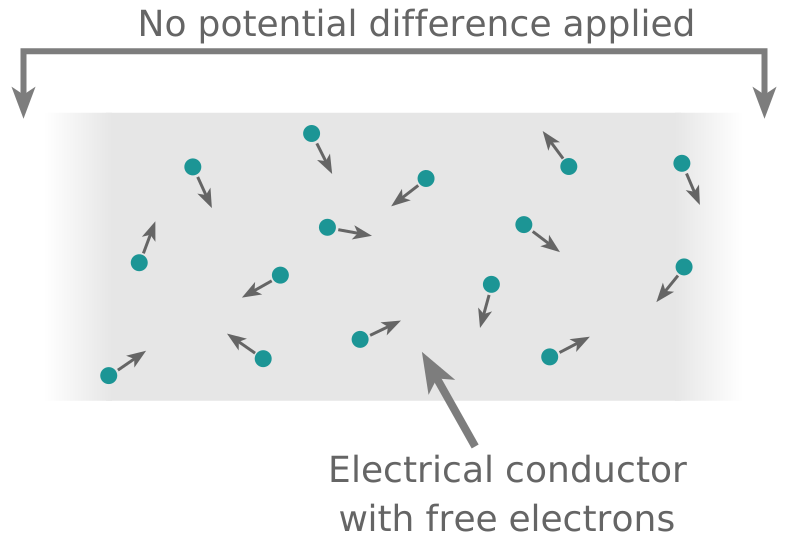
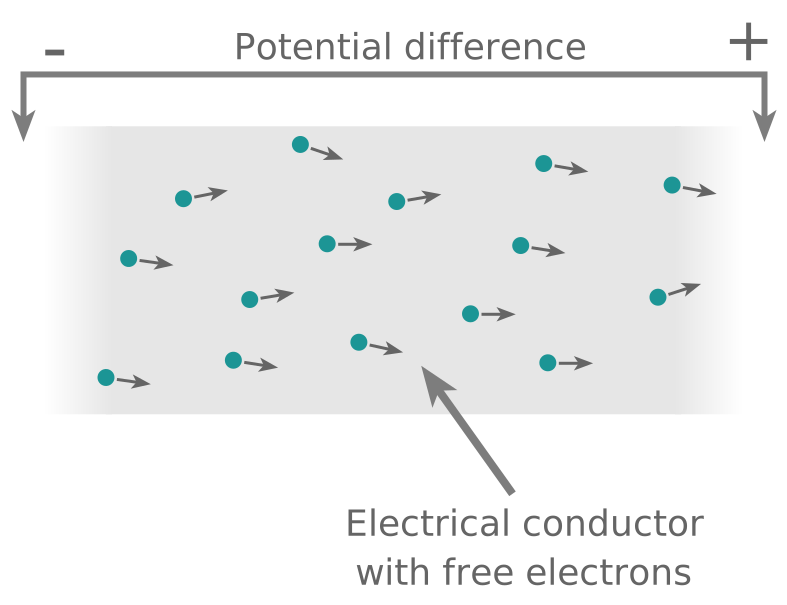
If a force acts on the electrons to move them in a particular direction, then they will all drift in the same direction, although still in a somewhat haphazard fashion, but there is an overall movement in one direction.
The force that acts on the electrons is called and electromotive force, or EMF, and its quantity is voltage measured in volts.
To gain a little more understanding about what current is and how it acts in a conductor, it can be compared to water flow in a pipe. There are limitations to this comparison, but it serves as a very basic illustration of current and current flow.
The current can be considered to be like water flowing through a pipe. When pressure is placed on one end it forces the water to move in one direction and flow through the pipe. The amount of water flow is proportional to the pressure placed on the end. The pressure or force placed on the end can be likened to the electro-motive force.
When the pressure is applied to the pipe, or the water is allowed to flow as a result of a tap being opened, then the water flows virtually instantaneously. The same is true for the electrical current.
To gain an idea of the flow of electrons, it takes 6.24 billion, billion electrons per second to flow for a current of one ampere.
Conventional current and electron flow
There is often a lot of misunderstanding about conventional current flow and electron flow. This can be a little confusing at first but it is really quite straightforward.
The particles that carry charge along conductors are free electrons. The electric field direction within a circuit is by definition the direction that positive test charges are pushed. Thus, these negatively charged electrons move in the direction opposite the electric field.
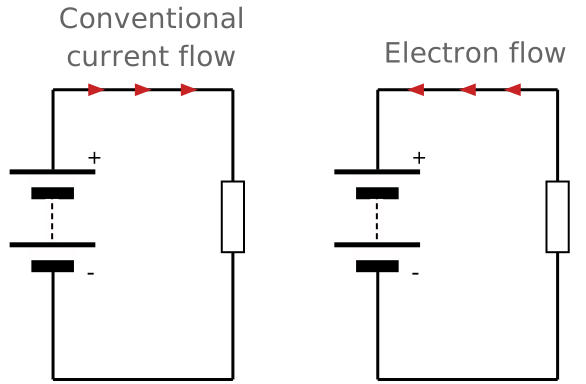
This came about because the initial investigations in static and dynamic electric currents was based upon what we would now call positive charge carriers. This meant that then early convention for the direction of an electric current was established as the direction that positive charges would move. This convention has remained and it is still used today.
In summary:
- Conventional current flow: The conventional current flow is from positive to the negative terminal and indicates the direction that positive charges would flow.
- Electron flow: The electron flow is from negative to positive terminal. Electrons are negatively charged and are therefore attracted to the positive terminal as unlike charges attract.
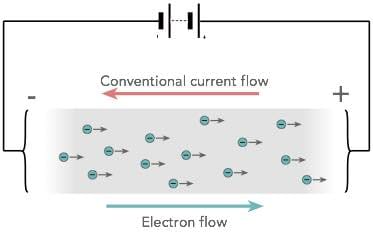
This is the convention that is used globally to this day, even though it may seem a little odd and out-dated.
Speed of electron or charge movement
The speed of the transmission of electrical current is very different to that of the speed of the actual electron movement. The electron itself bounces around in the conductor, and possibly only makes progress along the conductor at the rate of a few millimetres a second. This means that in the case of alternating current, where the current changes direction 50 or 60 times per second, most of the electrons never make it out of the wire.
To take a different example, in the near-vacuum inside a cathode ray tube, the electrons travel in near-straight lines at about a tenth of the speed of light.
Effects of current
When an electric current flows through a conductor there are a number of signs which tell that a current is flowing.
- Heat is dissipated: Possibly the most obvious is that heat is generated. If the current is small then the amount of heat generated is likely to be very small and may not be noticed. However if the current is larger then it is possible that a noticeable amount of heat is generated. An electric fire is a prime example showing how a current causes heat to be generated. The actual amount of heat is governed not only be the current, but also be the voltage and the resistance of the conductor.
- Magnetic effect: Another effect which can be noticed is that a magnetic field is built up around the conductor. If a current is flowing in conductor then it is possible to detect this. By placing a compass close to a wire carrying a reasonably large direct current, the compass needle can be seen to be deflect. Note this will not work with mains because the field is alternating too fast for the needle to respond and the two wires (live and neutral) close together in the same cable will cancel out the field.
The magnetic field generated by a current is put to good use in a number of areas. By winding a wire into a coil, the effect can be increased, and an electro-magnet can be made. Relays and a host of other items use the effect. Loudspeakers also use a varying current in a coil to cause vibrations to occur in a diaphragm which enable the electronic currents to be converted into sounds.
How to measure current
One important aspect of current is knowing the amount of current that may be flowing in a conductor. As electric current is such a key factor in electrical and electronic circuits, knowing what current is flowing is very important.
There are many different ways is measuring current. One of the easiest is to use a multimeter.
How to measure current with a DMM:
Using a DMM, digital multimeter it is easy to measure current by placing the DMM actually in the circuit carrying the current. The DMM will then give an accurate reading of the current flowing in the circuit
Find out how to measure current with a DMM.
Although there are other methods of measuring current, this is the most common.
Current is one of the most important and fundamental elements within electrical and electronic technology. The current flowing in a circuit can be used in a variety of ways from generating heat to causing circuits to switch, or information to be stored in an integrated circuit.
More Basic Electronics Concepts & Tutorials:
Voltage
Current
Power
Resistance
Capacitance
Inductance
Transformers
Decibel, dB
Kirchoff's Laws
Q, quality factor
RF noise
Waveforms
Return to Basic Electronics Concepts menu . . .