
Meteor Scatter Communications for Amateur Radio
Meteor scatter communications is a form of radio propagation used by ham radio operators using with modes including high speed Morse and WSJT / FSK441 for contacts over distances up to about 2000km.
Amateur radio & propagation includes:
Propagation & techniques basics
Operating via sporadic E
Meteor scatter
Auroral-propagation operation
Moonbounce EME operation
Meteor scatter communications has been used by ham radio VHF enthusiasts for many years. Using meteor scatter propagation enables ham radio and also commercial radio communications contacts to be made over distances up to about 2000 km on the VHF bands
Meteor scatter does require the use of high performance ham radio stations and some specialised operating techniques, but it is able to provide interesting contacts over distances up to around 2000 km or so.
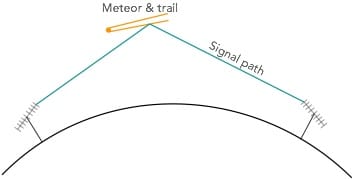
Basics of meteor burst radio communications
As the name suggests, meteor scatter propagation relies on the vast numbers of meteors that enter the earth’s atmosphere each day. Most are very small, often the size of a pebble or even a grain sand. At times the numbers of meteors increase when there is a meteor shower - these occur at specific times during the year. During these showers, amateur radio meteor scatter enthusiasts are able to make considerably more contacts.
Note on meteor scatter propagation:
Meteor scatter or meteor burst communications uses a form of radio propagation that utilises the dense trails of ionisation left by meteors as they enter the upper layers of the Earth's atmosphere. The trails are dense and can reflect signals into the VHF and soemtimes the UHF region of the radio spectrum, but they are only present for a very short time, and therfore the radio system must be able to accommodate this.
Read more about Meteor Scatter Propagation
There are two types of meteor trail that are generated:
- Under-dense meteor trails: Under-dense trails usually rise to a peak in a few hundred microseconds and then gradually fade away. They may only lasts a few tenths of a second whilst others may last for a few seconds. They fade as the electrons spread out from the main trail and the level of ionisation decreases. Under-dense trails are far more common than the over-dense ones, occurring randomly as well as within meteor showers. These trails are used more for commercial radio communications applications. They are also used for ham radio communications, although as the levels of ionisation are less than the over-dense trails, the frequencies supported are generally not as high.
- Over-dense meteor trails: The trails last for longer than the under-dense ones, and this makes it feasible to transfer data using modes like WSJT as well as high speed Morse or occasionally SSB. However the trails are less frequent than the under-dense ones because they require larger meteors to produce them and generally they are only experienced at or near the peak of major meteor showers. Additionally, the reflections they produce sometimes have large signal strength variations as well as producing some multipath effects that can cause problems with some forms of high-speed data transmission. Nevertheless these trails are ideal for ham radio operation.
The meteor trails are sufficiently ionised to enable scattering of radio signals in the range of about 10 MHz up to even as high as 1 GHz on occasions.
The bursts of signal created by such trails are commonly referred to as "pings", due to their characteristic sound and these pings may only last for as little as a tenth of a second. Nevertheless this is sufficient to carry some information, although several pings may be needed to complete a contact.
Frequency bands for ham radio meteor scatter
Meteor scatter or meteor burst radio communications can be used on a wide variety of frequencies. For ham radio most of the communications take place on the two metre band, although there are some contacts made on the 70 centimetres ham radio band, but this is very close to the absolute top limit for this form of radio propagation.
Some meteor scatter operation takes place on the 50MHz ham radio band. The lower frequencies here mean that the reflections are more effective. However on occasions, around the peak of the sunspot cycle, propagation is more likely to take place as a result of ordinary ionospheric propagation. This is one of the factors that determines the lower limit for meteor scatter radio communications.
Modes for ham radio meteor scatter
Meteor scatter communications can be very different to what may be termed the more normal or traditional forms of radio communications used by ham radio operators. The bursts of short-lived signal paths between the two ham radio stations means that special techniques are required. To achieve this specialised protocols or ways of worked were developed to enable the communication to be established and the information passed effectively between the two stations. A single meteor trail may only support a number of the steps needed to exchange information, and a complete contact may require the use of several meteor trails over a period of time.
A variety of transmission modes can be used with meteor scatter. For ham radio users in Europe the use of high speed Morse was popular. Using Morse transmissions speeds up to 800 words a minute were used. Originally the Morse was pre-prepared and speeded up using tape recorders, the reverse process being used to enable it to be deciphered later. For ham radio operators in North America Single Sideband was widely used.
The widespread availability of computers now means that they can be used to provide much greater levels of flexibility. Not only can they be used for the generation and reception of high speed Morse, but they have also enabled the creation of specialised transmission modes developed especially for meteor scatter operation.
One popular form of transmission for use in ham radio with its associated computer programme is known as WSJT. Developed for ham radio use by K1JT it was written explicitly for amateur radio meteor scatter communication. It only requires the use of a computer sound card, and possibly an interface box to ensure the right levels are presented to each input. This makes it ideal for use within ham radio as little new equipment is needed.
WSJT includes several “sub-modes” that can be used. The first mode, and the one that is most widely used is known as FSK441. It employs multi-frequency shift keying with four tones and a data rate of 441 baud. The system is also self-synchronising, as a result of the character codes used in the protocol and this has the advantage that it does not require an explicit synchronization tone. FSK441 is generally used on the 2 metre and 70 centimetre amateur radio bands.
WSJT in the FSK441 or JT6M modes can utilise very short pings, and this means that communication does not rely on the longer pings normally only found during meteor showers. Accordingly it can be used at any time, i.e. for under-dense and over-dense meteor trails.
Equipment for ham radio meteor scatter
It is possible to use a variety of equipment for amateur radio meteor scatter communications. Understanding the propagation mode and the requirements enables many stations to be used. Fortunately the performance of modern ham radio equipment is much higher than many older items and this means that it meets the requirements for meteor scatter communication much better.
Some of the main requirements are summarised below:
- Transmitter power: Often a reasonable level of power is required. In view of the reflections achievable on 50 MHz lower power operation is possible, but in 144 MHz and higher powers of 100 watts (or higher if the licence requirements allow them) are needed at the antenna feedpoint.
- Antenna gain: Although less gain is needed on 50 MHz (which is fortunate in view of the antenna sizes) on 144 MHz gains of 10 - 15 dB are advisable. Often 13 to 17 element beams are popular at 144 MHz. Although some amateur radio stations have more directional antennas with higher gain, this can reduce the area over which reflections can be seen and used. It is a balance between the number of reflections seen and the gain needed.
- System noise figure: The noise figure of the overall system needs to be low. Typically around 2.5 dB. Although a transceiver may have a good noise figure, any losses in the feeder will degrade this by an amount equal to the loss. Low loss coax feeder is essential. Often masthead pre-amplifiers will help this as they will amplify the signal before the loss of the cable and reduce the impact of the losses. Care must be taken to ensure the pre-amplifier gain is not too high otherwise the front end of the transceiver could become overloaded and the performance degraded.
- Frequency setting: In the past accurate frequency setting was an issue. A tolerance of ± 500Hz was needed for Morse and ± 200 Hz for SSB. Stability is even more important when using WSJT. Most of today’s modern amateur radio transceivers are able to offer sufficient stability, although beware, the dial readout does not necessarily equate to the actual signal accuracy.
- Computer: Most of today’s amateur radio meteor scatter communication is driven by computers. Accordingly a computer with the relevant software and interfaces is necessary to support the modes and operation.
Meteor scatter communications, or as it is sometimes called, meteor burst communications is a particularly interesting mode of radio communications open to ham radio operators, and it can be used to very good effect at VHF. It offers a form of propagation that can be used to provide contacts over distances up to a maximum of around 2000 km, and as such it is unique at these frequencies.
More Ham Radio Topics:
What is ham radio
Callsigns
Morse code
Voice modes
Digital data modes
QRP operating
Operating awards
Codes & abbreviations
Ham bands overview
Operating via differnet propagation modes
Repeaters
Callsigns
Contact formats
Setting up a shack & buying equipment
Return to Ham radio menu . . .