
What are LEDs, Light Emitting Diode, LED: types, symbols, applications, etc
The use of light emitting diodes, LEDs is huge and their use is growing as the technology advances and more LED types are introduced.
Home » Electronic components » this page
Light Emitting Diode Tutorial Includes:
Light emitting diode
How does a LED work
How a LED is made
LED datasheet specifications
LED lifetime
LED packages
High power / brightness LEDs
LED lighting technology
LED COBs
Organic LEDs, OLEDs
Other diodes: Diode types
Light emitting diodes, LEDs are very widely used in today's electronics equipment and they are one of the major display technologies in use today.
LEDs, light emitting diodes are used in many electronic circuit designs and other applications. Not only are they used as panel indicator lamps, but they are also used as alphanumeric displays, and now they are widely used for lighting in a variety of ways including domestic and offie lighting.

In recent years there has been a revolution in the development of LED technology and this has resulted in them being used in many more areas, and this trend is only likely to increase as the technology develops further.
Not only is their use for lighting applications increasing, but with organic LED technology also being developed and introduced, LEDs will only be used in a greater number of areas.
LED history
The story of the LED commences with soem early observations that, at the time were not understood. Investigating the performance of crystal radio detectors, H J Round noted te glowing of some of the samples.
Over the years, others observed these effect, even undertaking considerable levels of research. In the 1920s Oleg Losov in Russia performed a considerable amount of research into the effect, but sadly his work was lost in the Second World War. Others also made soem significant investigations.
However it was not until the 1960s that there was sufficient understanding of semiconductor physics and the supporting technology to make repeatable visible light emitting diodes.
One of the first visible light emitters came from SERL at Baldock in the UK, and laterin 1962, Nick Holonyak, Jr. of General Electric invented an LED that could produce visible red light.
In the mid to late 1960s small LED indicator lamps started to be used in electronic circuit designs and since then their proces have fallen and their usage increased and the development in technology has broadened the number of applications where they find uses.
Note on Light Emitting Diode History:
The first reports of diodes emitting light appear to have been made by an English radio engineer named H J Round in 1907. Since then many attempts were made to bring the LED to the world, but fate seemed to prevent this until allied technologies were far more mature.
Read more about Light emitting diode, LED history.
Light emitting diode, LED symbol
The circuit symbol for the LED is relatively straightforward. The LED symbol comprises a diode symbol with two arrows indicating outwards to signify that light emanated from the diode.
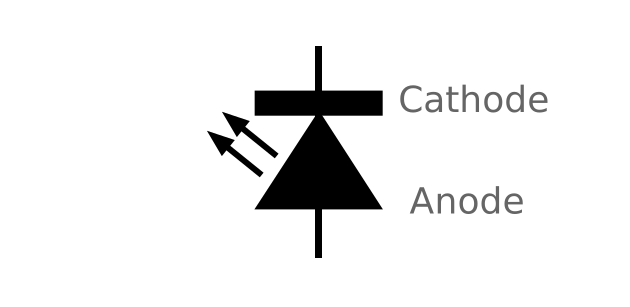
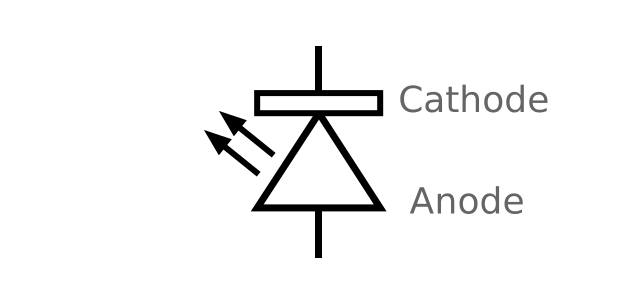
Sometimes the light emitting diode symbol is shown only as an outline and without the filled in shapes. The outline shape is equally acceptable,
Other versions of LED symbols may also be seen. Sometimes the light emitting diode symbol may be enclosed in a circles. This symbol is not as widely used these days but may still be seen on many circuits.
What is a LED
A LED or light emitting diode is a form of semiconductor diode that when a forward voltage is applied toth e diode and current passed though it emits light.
The diodes are normally made from a compound semiconductor with materials like: Gallium arsenide phosphide, GaAsP; Aluminium gallium indium phosphide, AlGaInP; Gallium phosphide, GaP; and many other compound semiconductors being used. These materials are in the series of what are called III-V group of semiconductors.
The type of material and the construction governs the colour of the light emitted.
The LED operates because energy is released in the form of photons on recombination of the holes and electrons in the diode. In standard PN junction diodes, any energy that is released is in the form of heat. For light-emitting diodes, the energy is released in the form of photons, of light in a process known as electroluminescence.
LED types
Since the introduction of the first LEDs, the technology has spawned a huge variety of different types of LED, each with their own properties and applications.
Traditional inorganic LEDs: This type of LED is the traditional form of diode that has been available since the 1960s. It is manufactured from inorganic materials. Some of the more widely used are compound semiconductors such as Aluminium gallium arsenide, Gallium arsenide phosphide, and many more – the colour of the light is often dependent upon the materials used.
These LEDs are typified by the small LED lamps that are used as panel indicators, although there are very many formats for LEDs of this type. However even within the inorganic LED category, there are many different styles of LED that can be seen and used:
- Single colour 5 mm, etc - the very traditional LED package
- Surface mount LEDs
- Bi-colour and multicolour LEDs - the types of LEDs contain several individual LEDs that are turned on by different voltages, etc.
- Flashing LEDs - with a small time integrated into the package
- Alphanumeric LED displays
- . . . . . more . . . .
All these different types of inorganic LED are used in very large quantities.
High brightness LEDs: High brightness LEDs, HBLEDs, are a type of inorganic LED that are starting to be used for lighting applications. This type of LED is essentially the same as the basic inorganic LED, but has a much greater light output. To generate the higher light output, this LED type requires to be able to handle much higher current levels and power dissipation. Often these LEDs are mounted such that they can be mounted onto a heatsink to remove the unwanted heat.
In view of their greater efficiency, this type of LED is being used as a replacement for many more traditional forms of lighting. Domestic lighting along with automotive lamps are now in widespread use. They have advantages in terms of efficiency and environmental factors over incandescent and Compact Fluorescent Lightbulbs, CFLs. The HBLEDs have a greater efficiency level and they also have a longer life, especially when being switched on and off many times. However they do have a finite life, a factor that is sometimes overlooked.
COB LEDs: Chip-On-Board LEDS have been introduced and they consist of a matrix of LEDs bonded to a substrate. These COB LEDs are idea for lighting as they enable the individual LED dies to be mounted closer to one another than would be possible with either leaded of SMD LEDs and they are also able to provide a very even light over the area of the overall COB LED.
Mounting them ona substrate has a number of other advantages including greater ease of heat removal and hence lower operating temperatures for high brightness and current levels. Also the fact that they are not soldered to a board but bonded to substrate significantly improves their reliability. They are also much easier to handle ina production or manufacturing environment because only a single COB LED is required rather than a large matrix of individual LEDs.
Organic LEDs: Organic LEDs are a development of the basic idea for the light emitting diode. This type of LED uses organic materials as the name indicates.
The traditional types of light emitting diode utilise traditional inorganic semiconductors with varying dopant levels and they produce light from the defined PN junction - often this is a point of light. The organic type of LED display is based on organic materials which are manufactured in sheets and provide a diffuse area of light. Typically a very thin film of organic material is printed onto a substrate made of glass. A semiconductor circuit is then used to carry the electrical charges to the imprinted pixels, causing them to glow.
With LED technology improving all the time, the efficiency levels of all the different types of LEDs is bound to improve, and their use will increase.
LED colours
Traditional inorganic LEDs are available in a variety of colours. The first LEDs to be produced were red, but since then many other colours have been introduced.
Of the colours available the blue and white LED types are more expensive than LEDs in other colours as a result of the higher manufacture costs.
In addition to the LEDs that emit visible light, others are manufactured to emit infra-red. These ones are often used for applications such as television remote controls where no visible light is seen.
The colour of a light emitting diode is determined by the semiconductor material used in the diode. Although the plastic body of the diode may appear to be coloured, this is not what gives the diode its colour.
Multicolour LEDs
Sometimes it can be very useful to have a lamp that has more than one colour, indicating a different colour to indicate a different state. This can be done using LEDs. There are two sorts:
- Bi-colour LEDs A bi-colour LED is constructed by having two LEDs in parallel with each other in the same package, but they are wired with one external connection of the package going to the cathode of one diode, and the anode of the other. The other lead is again connected to the anode of the first diode and the cathode of the second. In this way when a voltage is applied one way round, one LED will light, and when it is applied the other way round, the other one will light.
- Tri-colour LEDs This type of LED has three leads enabling any combination of LEDs to be light, i.e. the first LED, the second, or both. The most popular form of tri-colour LED uses a red and green diode. This means that when one diode is on, then either red or green is produced. If both are light, then the colours combine to form yellow.
Being able to use multi-colour LEDs can be a significant advantages in many electronic circuit designs because they are able to provide status indications, etc by the use of multiple colours. There are of course very many other applications for multicolour LEDs in a whole host of other applications and circuit designs.
Although LEDs will continue to be very widely used as small indicator lamps, the number of applications they can find is increasing as the technology improves. New very high luminance diodes are now available. These are even being used as a form of illumination, an application which they were previously not able to fulfil because of their low light output. New colours are being introduced. White and blue LEDs, which were previously very difficult to manufacture are now available. In view of the ongoing technology development, and their convenience of use, these devices will remain in the electronics catalogues for many years to come.
 Written by Ian Poole .
Experienced electronics engineer and author.
More Electronic Components:
Batteries
Capacitors
Connectors
ADC
DAC
Diodes
FET
Inductors
Memory types
Phototransistor
Quartz crystals
Relays
Resistors
RF connectors
Switches
Surface mount technology
Thyristor
Transformers
Transistor
Unijunction
Valves / Tubes
Return to Components menu . . .

 Check out my growing selection of fascinating and useful electronics related merchandise - you'll be surprised at what we have, so don't miss out!